
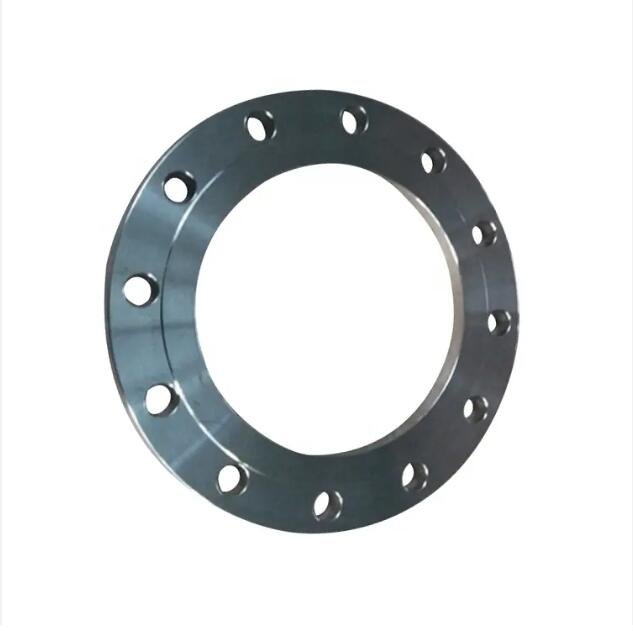
A plate flange is the simplest flange design in piping: a flat stainless steel disc with a bore, a bolt circle and a sealing face, and no tapered hub. European drawings call it Type 01 of EN 1092-1, and buyers in several Asian markets write PL. The label changes; the part does not.
That simplicity makes plate flanges economical and quick to fit, and also sets their limits. This guide covers the design, the standards on drawings, the dimensions that decide fit and rating, and the material questions to settle before a quotation. Final selection must be confirmed against the applicable standard, the project specification and a qualified engineer.
What Is a Plate Flange?
Machine a bore through a circular plate, drill a bolt circle and face the sealing surface, and you have a plate flange. No hub, no gradual transition into the pipe wall: that is what separates it from a weld neck or slip-on flange.
The pipe passes through the bore until it reaches the back of the face, and the joint is closed with a fillet weld. With no hub to spread load, thickness and weld detail carry the duty — efficient in material and machining, which is why plate flanges are common on water, utility, HVAC and general service lines at moderate pressure and temperature.

Plate Flange, Slip-On and Weld Neck: How They Differ
The plate flange is a flat disc; the slip-on has a short hub the pipe passes through; the weld neck has a long tapered hub butt-welded to the pipe.
| Point | Plate flange (EN 1092-1 Type 01) | Slip-on flange (ASME B16.5) |
|---|---|---|
| Profile | Flat disc, no hub. | Disc with a short hub above the face. |
| Pipe connection | Pipe passes through the bore and is fillet-welded. | Pipe passes through the bore and is fillet-welded, often inside and outside the hub. |
| Stiffness | Depends on plate thickness alone. | Hub adds local stiffness at the joint. |
| Dimensional basis | EN 1092-1, sized by DN and PN. | ASME B16.5, sized by NPS and Class. |
| Typical use | Moderate pressure and temperature, utility and process lines. | Process piping where an ASME B16.5 joint is specified. |
A plate flange is not a thinner slip-on: the two follow different standards, with different outside diameters, bolt circles and facing details, so neither replaces the other without checking the mating flange.
Standards and Designations on Drawings
EN 1092-1 Type 01
In the European system, plate flanges for welding are Type 01 of EN 1092-1. Size is DN, rating is PN, and the face is a lettered form: form A is flat, form B is raised. A drawing shows all three, for example “EN 1092-1 Type 01/A, DN 100, PN 16”.
A European fittings maker (HECo) lists Type 01/A plate flanges in PN 40 from DN 10 upwards, in 1.4571, 304L and 316L, with a sealing face turned to Ra 3.25–12.5 µm — the combination a purchase order has to reproduce.
Where ASME B16.5 Fits, and Where It Does Not
ASME B16.5 covers ratings, materials, dimensions, tolerances, marking and testing for inch-system flanges in Classes 150 to 2500, NPS 1/2 to 24, alongside the ASME B31 piping codes.
Crucially, B16.5 is limited to cast or forged flanges, with plate permitted only for blind and certain reducing flanges; there is no plate flange type in B16.5. A part cut from plate and sold as a “B16.5 slip-on” may match the dimensional envelope while failing on product type and material specification.
PN and Class are not interchangeable either. A PN 16 and a Class 150 flange look comparable in duty, but outside diameters, bolt circles, bolt sizes and facing details differ: quotations for “DN 100 PN 16” and “NPS 4 Class 150” are not quotations for the same part.
Dimensions That Decide Fit and Rating
Five dimensions drive most fit problems: outside diameter (D), bolt circle (k), bolt hole size and count, thickness (b) and bore (d1). Face diameter and face height then decide whether the gasket seats correctly. Published PN 40 Type 01/A data from a European maker gives:
- DN 50: outside diameter 165 mm, bolt circle 125 mm, 4 holes for M16, thickness 20 mm.
- DN 100: outside diameter 235 mm, bolt circle 190 mm, 8 holes for M20, thickness 26 mm.
- DN 150: outside diameter 300 mm, bolt circle 250 mm, 8 holes for M24, thickness 30 mm.
Treat these as an illustration, not a universal table: thickness changes most with rating and is the dimension most often missing.
Material Selection and Documentation
Plate or Forging
This is where plate flanges most often fail a paperwork review. ASTM A182/A182M covers forged or rolled alloy and stainless steel pipe flanges up to 10 000 lb (4 540 kg) per piece and stands behind most forged stainless flanges. Plate flanges are normally cut from plate and certified to ASTM A240/A240M, which covers stainless plate, sheet and strip for pressure vessels and general applications.
Both routes can produce a sound part, but the certification differs. If a datasheet demands A182, an A240-certified plate flange does not comply, even when the grade designation is identical. Raise it before the order, not at inspection. Inspection documents are commonly requested to EN 10204 type 3.1, so state the grade, material specification, heat number and marking they must show.
Grades in Common Use
304/304L and 316/316L cover most demand. Low-carbon L grades are preferred where the part will be welded, because they reduce sensitisation risk in the heat-affected zone. 316/316L adds molybdenum for better chloride resistance, 316Ti (1.4571) suits stabilised-grade requirements at elevated temperature, and duplex 2205 (1.4462) appears where higher strength or chloride stress-corrosion resistance is needed. Grade choice is a corrosion-engineering decision driven by fluid, concentration, temperature and environment.
Face Finish, Gaskets and Bolting
Form A flanges have a flat face and normally take a full-face gasket covering the bolt circle; form B flanges have a raised face, and the gasket sits on it. The forms do not mix: flat must mate with flat, raised with raised, otherwise load concentrates and leaks follow.
Face finish is specified numerically: the data quoted above gives Ra 3.25–12.5 µm, which suits standard compressed fibre, graphite and PTFE gaskets; softer gaskets may need a finer finish, so the gasket supplier’s requirement belongs in the order. Gaskets are specified separately, for example to EN 1514. Bolting follows the flange standard: metric bolts on EN plate flanges, inch bolts on ASME, tightened in a cross pattern in stages.
Welding and Installation Notes
Plate flanges are forgiving to fit but not to abuse. The pipe should slide into the bore without forcing, the face should sit square to the pipe axis, and the root gap should stay within the welding procedure. Pulling a misaligned pipe into position with bolts preloads the joint before it sees pressure. A fillet weld on each side is normal; on thicker sections the specification may require full penetration, which is a design decision, not a fabricator’s choice. Welding heat distorts thin plate flanges, so sequence and interpass control matter on large diameters.
Procedure and welder qualification, post-weld treatment and non-destructive examination come from the governing code, and should be agreed in writing before production.
Plate Flange Specification Checklist
An enquiry that answers these points can be quoted without clarification:
- Standard and type: EN 1092-1 Type 01, or the project datasheet.
- Size: DN (or NPS) and pipe outside diameter.
- Rating: PN or Class, with design pressure and temperature.
- Face form: A or B, and the mating flange.
- Material grade and material specification, for example 316L to ASTM A240.
- Bore and thickness, if they differ from standard tables.
- Face finish in Ra, plus any gasket supplier requirement.
- Quantity, including spares.
- Inspection and documentation: certificate type, PMI, marking.
- Surface condition, passivation, protection and export packaging.
Frequently Asked Questions
Is a plate flange the same as a flat flange?
In trade language they are used interchangeably, because the face is flat. The controlled description is the standard designation, such as EN 1092-1 Type 01/A with a stated DN and PN; when drawing and catalogue disagree, the drawing governs.
Can a plate flange be used in high-pressure service?
That is a design question. With no hub, capability depends on thickness, material, bolting, gasket and design conditions together. Whether one suits a high-pressure or cyclic line must be confirmed against the code and by a qualified engineer.
What does PL mean on a flange schedule?
PL is the short code used in several markets for a plate flange, as WN denotes weld neck and SO slip-on. The code alone is not a specification: the schedule still needs standard, size, rating, face form, material and finish.
Can I order a plate flange to ASME B16.5?
B16.5 defines no plate flange type and limits plate material to blind and certain reducing flanges. If the project is B16.5, specify a type the standard lists; if it is European, specify EN 1092-1 Type 01 and keep the systems separate.
Are PN and Class ratings equivalent?
No. They come from different standards with different dimensional tables and rating bases. A PN 16 and a Class 150 flange may serve comparable duty, but their dimensions and bolt patterns differ, so they are not interchangeable on an existing joint.
Conclusion
A plate flange earns its place by being simple: less material, less machining, faster fit-up, and a flat face suited to a full-face gasket. The same qualities define its limits: no hub spreads load, and thickness alone carries the duty.
The real work is in the specification: the right standard and type, correct DN and PN, a face form matching the mating flange, a grade backed by the right material specification, and documents that match the order. Get those right and most quality disputes never arise.
Need plate flanges for a project? Send the checklist above through our contact page and our team will confirm type, rating, face form and material against your specification. You can also review the plate flange range and the customised 304/316 PL flange options we produce, including the plate stainless steel flange series supplied in multiple sizes.
References
ASME. B16.5 – Pipe Flanges and Flanged Fittings: NPS 1/2 through NPS 24, Metric/Inch Standard. Official standard page.
ASTM. ASTM A182/A182M-24 – Standard Specification for Forged or Rolled Alloy and Stainless Steel Pipe Flanges, Forged Fittings, and Valves and Parts for High-Temperature Service. Official standard page.
HECo. Stainless steel plate flanges EN 1092-1 Type 01/A, PN 40 – technical product sheet. Manufacturer data sheet with dimensions and face finish.