
A socket weld flange and a lap joint flange are both economical ways to end a small-bore pipe at a bolted joint without the mass and weld preparation of a weld neck. Photographed side by side they can look interchangeable. In service they are not, because only one of them is welded to the pipe at all.
The choice is about welding, alignment, alloy cost and maintenance, not pressure class alone. This is general technical information: the governing standard edition, the project specification and a qualified engineer decide the final selection.
What each flange actually is
Socket weld flange: the pipe sits inside the flange
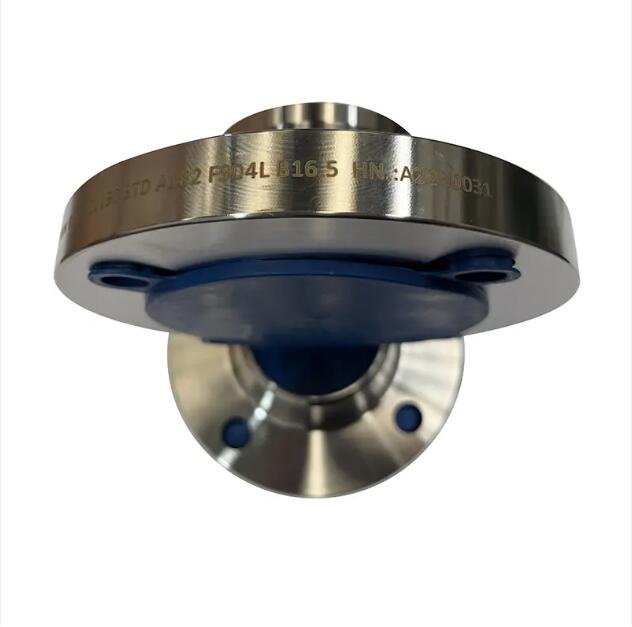
A socket weld (SW) flange has a counterbore, the socket, machined into the back of the flange. The pipe is inserted into that socket and joined with a single external fillet weld. There is no butt weld, no bevel and no weld on the inside.
Two dimensions govern the fit. The socket bore must clear the pipe outside diameter, and the socket depth must hold the pipe concentric without letting it bottom out. ASME B31.3 requires a gap between the pipe end and the socket bottom before welding; the figure normally quoted and checked on site is about 1.6 mm (1/16 in), so the pipe can move into the socket as the weld cools instead of loading the fillet.
The design consequence is a crevice: an unwelded annulus between pipe and socket wall, open to the fluid behind the weld. That is why socket welds are treated cautiously in corrosive duty, and why many hygienic specifications exclude them.
Lap joint flange: a backing ring that never touches the fluid
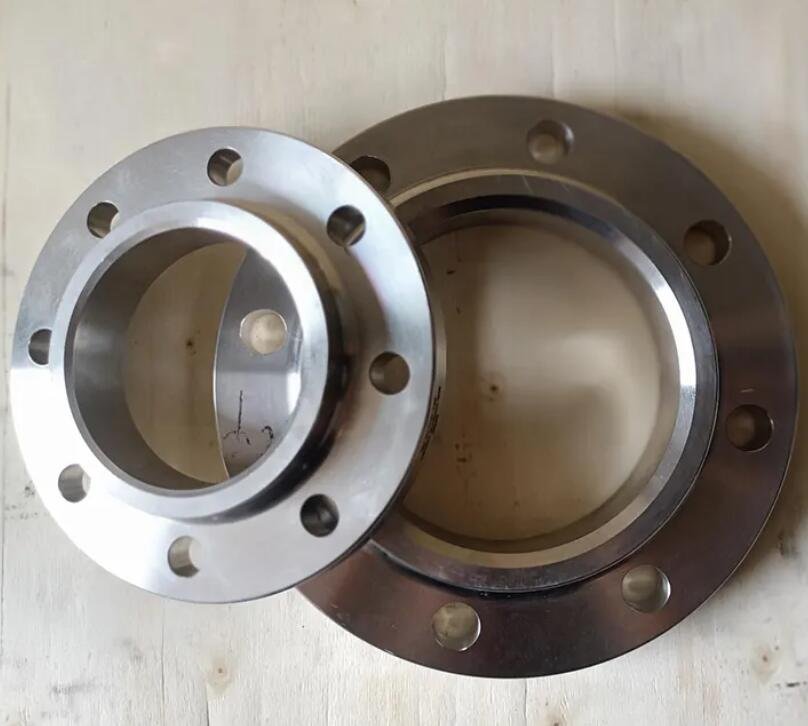
A lap joint (LJ) flange is half of an assembly. The pipe is butt welded to a stub end, a short piece with a flared lap, and the flange slides over the stub end from behind and bears against that lap. The flange is welded to nothing, is not wetted, and rotates freely until the bolts are tightened.
That explains the commercial logic. Because the flange never sees the process fluid, the wetted part can be an expensive alloy while the backing flange is a cheaper grade. The flange can also be rotated to line up bolt holes without turning the pipe spool, which matters when a line has to meet an equipment nozzle set out slightly off.
Side by side: the differences that decide the order
| Point of comparison | Socket weld flange | Lap joint flange |
|---|---|---|
| Attachment to pipe | One external fillet weld, pipe in socket | Stub end butt welded, flange loose |
| Wetted metal | Flange and weld see fluid; crevice remains | Only stub end and its weld see fluid |
| Alignment | Fixed once welded | Flange rotates to match bolt holes |
| Dismantling | Requires cutting the weld | Unbolt, stub end reusable |
| Alloy strategy | Whole flange in the wetted alloy | Alloy confined to the stub end |
| Pressure rating | Class rating, weld dependent on wall | Class rating for flange plus matching stub end |
| Cyclic duty | Fillet weld sensitive to cycling | Less rigid than a weld neck |
| Best fit | Small-bore utility and instrument lines | Corrosive duty, frequent dismantling |
Ratings: what the class number does and does not tell you
Both types sit in ASME B16.5, which covers Classes 150 to 1500 from NPS 1/2 through NPS 24, and Class 2500 from NPS 1/2 through NPS 12, and sets ratings, dimensions, tolerances, marking and testing for cast or forged flanges.
The class number does not state a working pressure. Class 150 is not 150 psi, and allowable pressure falls as temperature rises. Ratings are read from the tables by class, material group and design temperature, so two flanges of the same class in different alloys differ.
A lap joint assembly adds one more variable. The rating belongs to the flange and stub end together, so a stub end thinner than the pipe schedule, or in a weaker grade, changes what the joint can carry. Specify the stub end schedule and grade, not just the flange class.
Where a socket weld flange is the better answer
Socket welds are strong on small bore because they are quick, self-aligning and tolerant of fit-up. The socket holds the pipe concentric while tacking, and one fillet replaces the two welds a slip-on needs.
- Instrument, drain and vent lines where the connection is compact and access for a butt weld is poor.
- Shop fabrication, where a bench weld and a socket give repeatable alignment without a purge setup.
- Joints that will not be opened in service, so the crevice and the cut-to-remove penalty never matter.
The trade is permanent. Once the fillet is made, the joint cannot be opened without cutting, and the crevice cannot be cleaned.
Where a lap joint flange is the better answer
Lap joints win on alloy economics and maintenance access. A 316L or duplex stub end with a lower-grade backing flange puts expensive metal only where the fluid reaches, and the flange becomes a reusable ring rather than part of the pressure boundary.
- Corrosive service in an expensive alloy, where confining the alloy to the stub end cuts the cost of the wetted part.
- Joints opened for cleaning or changeover, where cutting a weld each time is unacceptable.
- Bolt-hole alignment problems, where a rotating flange solves in minutes what would otherwise be a re-drilled hole.
Where neither type belongs
- Severe cyclic service. A socket fillet concentrates stress at the weld toe and has no radiographable root, and a lap joint is less rigid than a weld neck. Where the piping code applies severe cyclic provisions, a weld neck is the defensible choice.
- Corrosive or erosive fluids. The socket crevice traps stagnant liquid, and the stub end lap leaves a gap where deposits collect.
- Hygienic systems. Crevices and unwelded interfaces are what cleanable design excludes.
- Large sizes. Weld quality and handling weight scale badly; above small bore, a weld neck is the usual specification.
Installation points that decide whether the joint holds
Socket weld. Confirm the gap before striking an arc, keep the socket clean and dry, and check the fillet leg length against the weld procedure. Penetrant or magnetic particle testing of the fillet is the practical examination; radiography is not. On thin-wall stainless, check the bore after welding for penetration or sugaring that would restrict flow.
Lap joint. Judge the fit at the stub end, not by the flange bore: the flange inside diameter is deliberately larger than the pipe so it can rotate. The stub end wall must match the pipe schedule, because the butt weld is made to it. Stud length has to cover two flange thicknesses plus two stub end laps, which is the mistake that shows up as short thread on site. The gasket seals against the stub end lap face, so that face has to be flat and undamaged.

What to write in the enquiry
Most wrong deliveries are created before quoting:
- Standard and edition: ASME B16.5, to the edition the project is designed to.
- Type: socket weld flange, or lap joint flange with stub end.
- Size and schedule: NPS with pipe schedule, not a bare nominal size.
- Class and facing: 150 to 2500, with RF, FF or RTJ.
- Flange material: ASTM A182 grade such as F304L, F316L or F51, with certificate type.
- Stub end: a separate line item with schedule, length and grade.
- Bore and socket: socket depth or bore dimension where the pipe is non-standard.
- Examination: dimensional report, PMI, and penetrant testing of fillets where required.
- Marking and packing: grade, size, class, standard and heat number legible on the rim, with sealing faces protected.
ASTM A182 covers forged or rolled alloy and stainless steel flanges, limits parts to 10,000 lb (4,540 kg), and binds the supplier to supplementary requirements only when the order states them.
Conclusion
The decision is narrower than the catalogue suggests. A socket weld flange is a fabrication convenience: one weld, self-aligning, compact, permanent. A lap joint flange is a maintenance and alloy strategy: a reusable ring around a stub end that carries the fluid and the weld.
If the line is small bore, utility duty and unlikely to be opened, socket weld is the efficient answer. If the fluid is corrosive, the alloy expensive, or the joint dismantled often, lap joint pays for its extra part. Neither substitutes for a weld neck in cyclic, high-temperature or hygienic service. Confirm the final selection against the applicable standard, the project specification and a qualified engineer.
Need socket weld or lap joint flanges with matching stub ends and documentation? Send the size, schedule, class, facing and grade through our contact page and the team will confirm what can be supplied and certified. You can also review the forged socket weld flange range, the lapped joint flange range, or the weld neck flange range where the line needs a butt-welded connection.
Frequently asked questions
Can a lap joint flange be used without a stub end?
No. The flange has no weld preparation and no way to attach to the pipe; the stub end provides both the butt weld and the lap the flange bears against.
Can a lap joint flange be welded to the pipe?
Not without defeating its purpose. Welding the backing flange removes the rotation that allows bolt-hole alignment and makes the flange part of the wetted boundary.
Is a socket weld flange stronger than a slip-on flange?
Both are rated by class in the B16.5 tables, and neither rating is set by the weld alone. The socket holds the pipe concentric with one weld; a slip-on needs two fillets but can be positioned before welding. Joint strength depends on weld procedure and pipe wall.
Do socket weld flanges exist above NPS 2?
The standard tabulates them well above that size, but project specifications commonly restrict socket-welded joints to small bore because the crevice and the fillet scale badly with diameter. Whether a larger size is acceptable is a project decision.
Do lap joint flanges need longer studs?
Yes. The stud passes through two flange thicknesses plus the two stub end laps, so the grip length is greater than for a weld neck pair of the same class.
References
ASME. B16.5-2020 – Pipe Flanges and Flanged Fittings: NPS 1/2 through NPS 24, Metric/Inch Standard.
ASTM International. ASTM A182/A182M – Forged or Rolled Alloy and Stainless Steel Pipe Flanges, Forged Fittings, and Valves and Parts for High-Temperature Service.
ASME. B31.3 – Process Piping.