
Duplex stainless steel flanges sit between the familiar 300-series austenitics and the nickel alloys on both cost and performance. A duplex flange carries roughly twice the yield strength of 316L and resists the chloride stress corrosion cracking that can split an austenitic flange in a warm, wet environment. That combination explains their presence on seawater systems, chemical plants, desalination trains and offshore packages.
For a buyer the question is narrower: 2205 or 2507? This guide compares the two families, shows where each is normally specified, and lists what to fix in the purchase order. Final grade selection must still be confirmed against the applicable code, the project specification and by a qualified engineer.
What makes a duplex flange different
Duplex stainless steels have a mixed microstructure of roughly equal ferrite and austenite. The ferrite contributes strength and resistance to chloride stress corrosion cracking; the austenite contributes toughness and weldability. Three consequences matter to a piping buyer.
Strength: minimum yield is roughly two to two and a half times that of 316L, which is why duplex is sometimes chosen to reduce wall thickness or flange mass. Cracking: under tensile stress in warm chloride service austenitic grades suffer stress corrosion cracking, while duplex grades are far more tolerant, though not immune to every mechanism. Pitting and crevice resistance is driven by chromium, molybdenum and nitrogen and expressed as a pitting resistance equivalent number (PREN).
The duplex family at a glance
The commercial names are loose. “2205” and “super duplex” cover several UNS numbers, so the purchase order should carry the UNS number and the ASTM grade.
| Common name | UNS / EN | Typical PREN and usual role |
|---|---|---|
| 2205 (A182 F60) | S32205 / 1.4462 | About 35. General-purpose duplex for process water, chemical and pulp and paper piping. |
| 2205 legacy (A182 F51) | S31803 / 1.4462 | About 34. Older 22 Cr duplex with a wider composition range. |
| 2507 (A182 F53) | S32750 / 1.4410 | About 42. Super duplex for seawater, high chloride and higher pressure duty. |
| Zeron 100 (A182 F55) | S32760 / 1.4501 | About 40 to 41. Copper and tungsten bearing super duplex for seawater systems. |
| 255 (A182 F61) | S32550 / 1.4507 | About 40. Copper bearing duplex with a history in cast and pump duties. |
PREN is chromium plus 3.3 times molybdenum plus 16 times nitrogen. The figures above are typical values quoted by material producers, not specification limits. Confirm the actual composition on the mill certificate.
2205 (UNS S32205 / A182 F60): the default duplex
S32205 is the grade most buyers mean when they say duplex. With around 22 percent chromium, 3 percent molybdenum and about 0.15 percent nitrogen it reaches a typical PREN near 35 and useful chloride resistance at moderate temperature. It is routinely made as weld neck, slip-on, blind and plate flanges in the usual ASME classes and face forms.
The S31803 versus S32205 distinction matters. Both are sold as 2205, but S31803 allows a wider composition window and lower nitrogen, so its pitting resistance can sit at the bottom of the range. Where chlorides are present, order S32205 and state the UNS number.
2205 suits process and cooling water with moderate chloride, chemical and petrochemical piping, pulp and paper, and structural components that benefit from the extra strength. It does not suit hot concentrated chlorides, severe crevice geometries in seawater, or any duty where the project specification calls for super duplex or a nickel alloy.
2507 (UNS S32750 / A182 F53): super duplex for severe chloride
S32750 raises chromium to about 25 percent, molybdenum to about 4 percent and nitrogen to roughly 0.27 percent, lifting typical PREN to about 42 and minimum yield above that of 2205. The higher alloy content buys pitting and crevice resistance in warm seawater and in chloride levels that would pit 2205. It is the grade normally seen on desalination high-pressure trains, seawater cooling, subsea manifolds and offshore process piping.
The premium is not only in the material. 2507 is less forgiving to weld: ferrite and austenite balance is harder to hold, nitrogen loss must be controlled, and consumables are more highly alloyed. A fabricator without a qualified procedure and a ferrite check can produce a flange that passes dimensional inspection and still underperforms in service.
Note that “super duplex” is a family, not a grade: S32750, S32760 and S32550 all sit under the label with different copper and tungsten additions. If a specification names super duplex without a UNS number, ask which one is intended.
Choosing between 2205 and 2507
| Selection signal | 2205 (S32205) | 2507 (S32750) |
|---|---|---|
| Chloride-bearing process water, moderate temperature | Usual choice | Usually over-specified |
| Seawater or high chloride with crevice risk | Marginal; needs assessment | Usual choice |
| Yield strength demand | Adequate for most lines | Higher strength, thinner sections |
| Welding and QA capability | Widely available | Needs qualified WPS and tighter control |
| Continuous service above about 300 C | Not suitable | Not suitable |
| Sour service with H2S | Qualify to ISO 15156 | Qualify to ISO 15156 |
The decision is made by the corrosion assessment, not by preference. If chloride level, temperature and crevice geometry sit inside the 2205 envelope, 2507 adds cost without adding life. If the assessment shows pitting or crevice risk under upset conditions, 2205 is the wrong bet.
Temperature limits: where duplex stops
Duplex grades are not high-temperature materials. Above roughly 300 C (570 F) the ferrite phase embrittles over time, and exposure to the 600 to 1000 C range can form sigma phase that destroys toughness and corrosion resistance. Many project specifications therefore cap continuous service at about 300 C. Duplex is not a substitute for 304H, 321 or an alloy steel in hot service.
At the low end, duplex retains useful toughness commonly to around minus 50 C, but that is not automatic. Where a low-temperature design condition applies, specify the impact test temperature and acceptance criteria.
Welding and fabrication
Matching fillers are ER2209 for 2205 and ER2594 for 2507, applied under a qualified procedure with controlled heat input, interpass temperature and effective root purging. Excessive heat input produces coarse nitride precipitation and an unbalanced microstructure; too little can leave insufficient austenite in the weld.
Duplex flanges are not post-weld heat treated, because stress relief in the sensitising range would do more harm than good; residual stress is managed by welding sequence and fit-up. Dissimilar joints to carbon steel usually need a nickel-based consumable and a procedure reviewed by the responsible engineer.
Standards, ratings and marking
Forged duplex flanges are normally ordered to ASTM A182/A182M, which covers grades F51, F53, F55, F60 and F61 among others. Plate flanges cut from plate fall under ASTM A240/A240M, and the specification should state whether a plate route is acceptable for the service. Dimensions, face forms and pressure-temperature ratings come from ASME B16.5 in the usual size range, with ASME B16.47 for larger sizes.
Dimensions are interchangeable with austenitic flanges of the same size, class and face, which is exactly why grade mix-ups happen. The rating follows the material group, and duplex derates differently from 316L at elevated temperature, so read the rating table for the specific grade rather than assuming a Class 150 duplex flange matches a Class 150 stainless one at every temperature.
Marking is the buyer’s first line of defence. A compliant flange carries the manufacturer, material designation, size and rating class, and normally a heat identifier too.
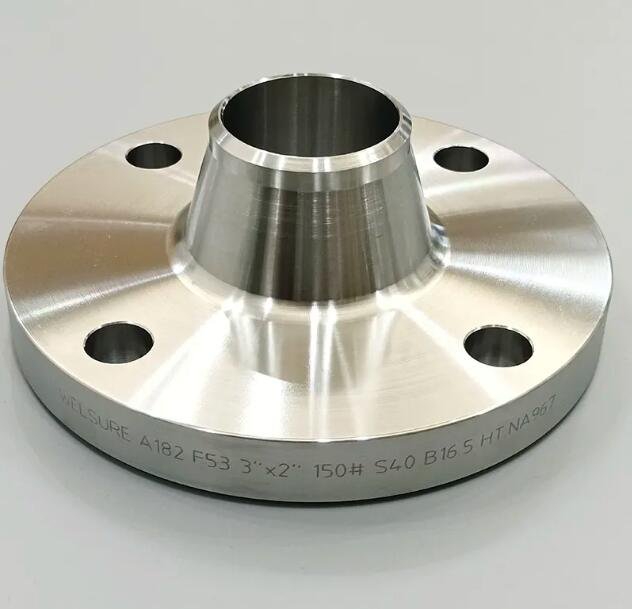
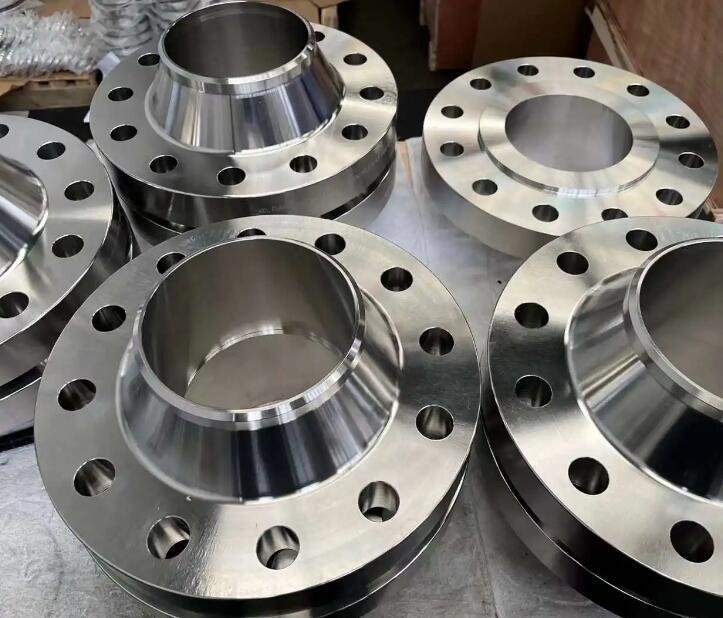
Duplex and austenitic flanges look identical on the bench. Finish, colour and machining marks say nothing about the grade, so verification comes from documents and testing: a certificate to EN 10204 3.1, positive material identification on the finished part, and a hardness check where the specification requires one.
What to put in the RFQ
A duplex enquiry that leaves these items open will come back with assumptions:
- Grade, UNS number and ASTM designation, for example 2507, UNS S32750, A182 F53.
- Size, class or PN, schedule or bore, and face form (RF, FF or RTJ).
- Dimensional standard and edition, such as ASME B16.5 or EN 1092-1.
- Flange type, and whether a forged or plate route is acceptable.
- Heat treatment condition and any solution annealing requirement.
- Inspection: PMI, hardness, ferrite content, NDT scope and acceptance criteria.
- Documentation: certificate type, mill certificates, third-party witnessing.
- Marking and traceability, including heat number transfer.
Frequently asked questions
Is duplex stronger than 316L?
Yes. Minimum yield for the 22 Cr duplex grades is roughly two to two and a half times that of 316L, which allows thinner walls where strength governs. The flange still has to satisfy the rating for its material group.
Can I replace a 316L flange with 2205 directly?
Dimensionally, usually yes for the same size, class and face. In every other respect it is an engineering change: welding procedure, consumables, NDT, gaskets and the rating table all need review and approval by the responsible engineer.
Can duplex flanges be used at high temperature?
Not above roughly 300 C in continuous service. Ferrite embrittlement and sigma phase formation reduce toughness and corrosion resistance. For hot service, specify an austenitic or alloy grade approved for the design temperature.
Which filler metal should be used for 2205 and 2507?
ER2209 for 2205 and ER2594 for 2507 are the usual matching consumables. The final choice belongs to the qualified welding procedure, and dissimilar joints to carbon steel normally need a nickel-based filler.
How can I verify the grade after delivery?
Read the marking, check the EN 10204 3.1 certificate against the order, and carry out positive material identification on the finished flanges. Visual inspection alone cannot separate duplex from austenitic stainless steel.
Conclusion
2205 covers most duplex flange demand: moderate chloride, moderate temperature, chemical and process water duty, at a cost that is easier to justify than super duplex. 2507 earns its premium where chloride load, temperature or crevice geometry would put 2205 at risk, and where the fabricator can weld it properly. The most common buying error is ordering a family name instead of a UNS number, then finding at inspection that the certificate says something else.
Fix the grade, UNS number, dimensional standard, inspection scope and documentation in the purchase order, and confirm the selection against the process data with the responsible engineer.
Need duplex or super duplex flanges to a stated grade and class? Send the size, rating, face form, schedule and required documentation through our contact page and we will confirm the specification before quoting. You can also review the 2205 duplex weld neck flange, the 2507 super duplex weld neck flange, or the full weld neck flange range.