
Most flanges are ordered from a dimension table: pick the size, pick the class, pick the facing. A long weld neck flange is different. It is usually ordered from a drawing, because the dimension that matters most — the length of the neck — is not in the table.
That single feature decides where the weld lands, how the joint is inspected, and whether the connection stays accessible once the line is insulated. This guide explains what a long weld neck (LWN) flange is, where it earns its higher cost, which dimensions have to be fixed before a quotation, and what to put in the purchase order. As with any pressure-containing component, the final selection must be confirmed against the governing code, the project specification and a qualified engineer.
What Is a Long Weld Neck Flange?
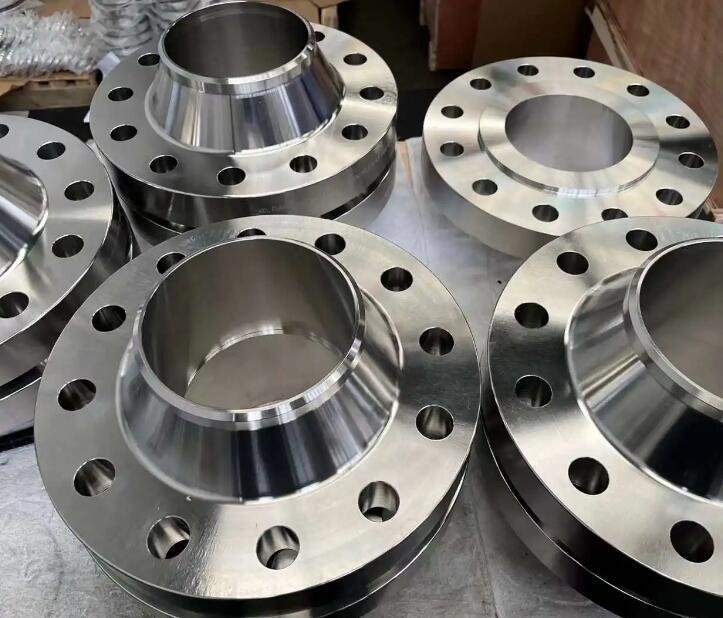
A long weld neck flange is a weld neck flange whose tapered hub is extended well beyond the standard length through hub, ending in a bevel that is butt-welded directly to a nozzle, a heavy-wall pipe or a header. The flange ring itself — outside diameter, thickness, bolt circle, bolt holes and facing — normally follows the ASME B16.5 tables for the size and pressure class. The neck does not.
ASME B16.5 tabulates a fixed length through hub for each NPS and class combination, and that value is what a standard weld neck is machined to. An LWN extends past it, often by two to four times, so the part becomes a made-to-drawing item rather than a catalogue item. The extra length is not cosmetic: it moves the butt weld out of a congested area and gives the welder and the inspector room to work.

Long Weld Neck vs Standard Weld Neck vs Slip-On
All three carry the same bolt pattern for a given size and class, so they mate with the same gasket and the same mating flange. What changes is how the part attaches to the pipe or nozzle, and how much of the assembly can be examined after welding.
| Point | Long weld neck vs standard weld neck and slip-on |
|---|---|
| Neck | LWN: extended tapered hub, length set by drawing. WN: short hub, length tabulated in B16.5. SO: short straight hub, no weld prep. |
| Attachment | LWN and WN: one butt weld at the neck. SO: two fillet welds, one at each hub face. |
| Examination | LWN: butt weld clear of the shell, RT or UT practical. WN: radiographable but often congested. SO: surface methods only. |
| Insulation | LWN: joint sits outside the lagging and stays accessible. WN and SO: joint buried under insulation. |
| Cost | LWN highest, with the longest machining time. WN moderate. SO lowest, a catalogue item. |
| Typical use | LWN: vessel nozzles, heavy wall, critical small bore. WN: general process piping. SO: utility and low-pressure lines. |
The economic argument is easy to get wrong. An LWN costs more than a weld neck, but it can remove one girth weld, one fitting and one hydrostatic test point from an assembly. On a small-bore nozzle, that saved weld is often worth more than the difference in flange price.
Where Long Weld Neck Flanges Are Used
Vessel and nozzle connections
On a pressure vessel, the nozzle-to-shell weld is already a critical joint. Adding a pipe stub and then a flange weld puts a second weld close to the first, where restraint is high and access is poor. A long weld neck flange replaces that stack with one butt weld set away from the shell, where it can be preheated, welded and examined properly. The shell-to-nozzle weld still exists — the LWN does not remove it — but the flange weld no longer crowds it.
Insulated, traced and clad piping
Where a line carries insulation, heat tracing or cladding, a standard flange joint disappears under the lagging until someone cuts the insulation away. An extended neck lets the flange face stand clear, so the joint can be broken for maintenance without destroying the thermal finish. The same applies where a flange must clear fireproofing or a wall penetration.
Small-bore and high-cycle service
Small nozzles on pumps, compressors and skids see vibration and thermal cycling. A single butt weld with a smooth neck-to-pipe transition creates fewer stress concentrations than a slip-on’s pair of fillet welds — a general preference, not a rule; cyclic limits must be assessed against the applicable code and project specification.

Dimensions That Must Be Settled Before Quoting
The flange ring and the neck are specified differently, and mixing the two is the most common source of a wrong part.
Ring dimensions
Size (NPS or DN), pressure class and facing fix the outside diameter, thickness, bolt circle, bolt hole count and diameter, and the face detail. For ASME work these come from ASME B16.5; for European work, EN 1092-1 applies, and the two systems are not interchangeable even at similar pressure ratings.
Neck length and neck thickness
Neck length is measured from the flange face to the bevel and must be on the drawing. Neck thickness is a separate decision: match the pipe schedule, match the nozzle wall, or go heavier to keep the bore transition gradual. For heavy-wall pipe, state the bore diameter rather than a schedule, since one schedule number covers different wall thicknesses across size ranges.
Bore, bevel and facing
The bore should match the connecting component closely enough to avoid an internal step; a small mismatch at the root is normal, a ledge is not. The weld end is normally bevelled to ASME B16.25 unless the drawing states otherwise. Facing is independent of neck length: raised face is the default, flat face is used for mating with cast iron or for soft gaskets, and a ring type joint groove is specified for high-pressure service.
Materials and Certificates
Stainless long weld neck flanges are typically forged to ASTM A182/A182M, in grades such as F304, F304L, F316, F316L, F51 and F53 for duplex, or F44 and nickel alloys for more aggressive service. Two procurement details in that specification matter more than the grade name:
- A182 limits a single piece to 10,000 lb (4,540 kg). Larger flanges fall under other specifications, so a very large LWN needs its material specification confirmed rather than assumed.
- Supplementary requirements — impact testing, hardness limits, grain size, additional NDT — apply only when the purchaser cites them individually in the order. Asking for “full A182” does not automatically buy them.
Grade selection itself depends on the medium, chloride level, temperature and welding procedure; a corrosion assessment is a project decision, not a catalogue one.
Inspection and Documentation
For a made-to-drawing part, inspection focuses on what a catalogue check would miss: neck length, concentricity, bore diameter, bevel angle and face flatness. Positive material identification is common on stainless and duplex grades, because appearance cannot separate 304 from 316L or 2205 from 2507. Penetrant testing of the neck and bevel is often requested where the weld will be radiographed.
Pressure testing is normally carried out on the assembled system rather than on the flange alone, unless the purchase order says otherwise. Marking should carry the grade, size, class, heat number and manufacturer’s mark, and the mill or manufacturer test certificate should be traceable to those marks.
RFQ Checklist for Long Weld Neck Flanges
- Drawing or sketch showing neck length from face to bevel, and the bore diameter.
- Size and pressure class, plus the dimensional standard (ASME B16.5, EN 1092-1 or project standard).
- Material grade with the ASTM specification year, e.g. A182 F316L.
- Facing type and finish, including the required surface roughness where a specific gasket is used.
- Weld end detail and bevel angle.
- NDT, PMI and hardness requirements, each stated explicitly.
- Supplementary requirements cited individually, not by reference to the whole specification.
- Marking, test certificate and packaging requirements.
For standard weld neck and slip-on items, the weld neck flange range covers the tabulated sizes; the full stainless steel flange catalogue shows the other types. Matching bore to pipe schedule is covered separately in the guide to flange bore and pipe schedule.
Frequently Asked Questions
Is a long weld neck flange covered by ASME B16.5?
Partly. The flange ring — outside diameter, thickness, bolt circle and facing — is normally dimensioned to B16.5 for the size and class. The neck length is not a tabulated B16.5 value, so a long weld neck is a made-to-drawing component and the drawing governs. B16.5 itself covers pressure-temperature ratings, materials, dimensions, tolerances, marking and testing for standard flanges and flanged fittings.
When is an LWN worth the extra cost over a weld neck?
When the extra neck solves a real problem: clearing insulation, moving a weld away from a shell or fitting, or replacing two welds with one on a small-bore critical line. If none of those apply, a standard weld neck does the same job for less money.
What neck length should I specify?
There is no universal figure. The length must be enough to clear the insulation or cladding, place the weld in an accessible position and satisfy the nozzle design. It comes from the project drawing and the engineer responsible for the connection, not from a supplier’s default.
Can a long weld neck flange have an RTJ facing?
Yes. Facing and neck length are independent choices, so a ring type joint groove can be combined with an extended neck where high-pressure service and insulation clearance are both required.
Does an LWN remove the nozzle-to-shell weld?
No. It removes the separate pipe-to-flange weld and the pipe stub, leaving one butt weld between the flange neck and the nozzle. The nozzle-to-shell weld remains and is still governed by the vessel code.
Conclusion
A long weld neck flange is a welding solution, not a stock item. Its value comes from where it puts the weld and how much access it leaves for inspection and maintenance; its cost comes from the extra forging and machining those benefits require. Specify neck length, bore, bevel and facing explicitly, state supplementary requirements one by one, and confirm the final selection against the applicable standard, the project specification and a qualified engineer.
If you have a drawing, send it with the grade, class, facing and quantity and we will quote against those details rather than against a generic size. Contact our team to start the enquiry.