
Heat exchangers turn two separate fluid circuits into one useful process duty, but they do not remove the need for a carefully specified bolted connection. At a nozzle, channel, bonnet, or piping tie-in, the flange has to match the pressure-temperature envelope, the pipe or equipment facing, the gasket system, and the inspection package. A part that looks correct in a photograph can still have the wrong bore, bolt circle, facing, material grade, or rating.

This guide gives procurement teams a practical way to define stainless steel flanges for heat exchangers. It is general purchasing information, not a design approval. The project engineer, piping class, equipment drawing, applicable code, and the owner’s specifications remain the final authority.
Where flanges appear on a heat exchanger
Flanges may connect exchanger nozzles to process piping, removable channel covers, bonnets, valves, instruments, or short spool pieces. The connection type depends on the exchanger construction and maintenance plan. Fixed-tube-sheet units may have fewer routinely opened flanged joints than U-tube or floating-head designs, while removable covers can make gasket replacement and inspection part of normal maintenance.
Before requesting a quotation, identify the exact joint on the general arrangement or nozzle schedule. “Heat-exchanger flange” is not enough to define a purchasable item. Record the nozzle number, nominal size, pipe or shell side, design pressure, design and operating temperatures, fluid, corrosion allowance, facing, and whether the flange is integral, weld neck, slip-on, blind, or a special equipment flange.
The specification decisions that control fit
1. Standard, size, and pressure-temperature rating
ASME B16.5 covers pipe flanges and flanged fittings from NPS 1/2 through NPS 24 and addresses pressure-temperature ratings, materials, dimensions, tolerances, marking, testing, bolting, gaskets, and flange joints. It includes rating classes such as 150, 300, 600 and higher classes within its stated scope. That does not mean a Class 300 label alone proves the joint is suitable: the rating is tied to material group and temperature, and the complete piping or equipment design must govern.
For larger diameters or a non-ASME project, another dimensional system may apply. Do not mix an ASME Class designation with a PN system or a different bolt pattern simply because the nominal diameter appears similar. Confirm the standard edition, units, nominal size, rating or PN designation, facing, and the mating flange standard on the drawing.
2. Material and corrosion environment
ASTM A182/A182M covers forged or rolled alloy and stainless steel pipe flanges, forged fittings, and valves and parts for high-temperature service. Its scope includes multiple low-alloy, austenitic, ferritic, martensitic, and ferritic-austenitic grades. Grade selection must follow the actual process: chloride exposure, acid or caustic chemistry, temperature, erosion, cleaning chemicals, and weld condition can all change the answer.
Do not select 304, 316L, a duplex grade, or a nickel alloy from a catalogue photograph. Put the required material designation and supplementary requirements in the purchase order. Ask for heat numbers and a material test report, and specify positive material identification (PMI) when the project requires it. If the equipment designer requires a weldability, solution-annealing, impact, hardness, or corrosion test, list it explicitly rather than assuming it is included.
3. Bore, facing, and gasket interface
The flange bore must suit the connected pipe, tube-side nozzle, or equipment neck. Schedule, wall thickness, lining, internal diameter, and weld detail may affect the bore choice. A nominally matching flange can still create a step, restriction, or weld mismatch if the bore is ordered generically.
Facing is equally important. Raised face, flat face, and ring-type joint arrangements use different gasket and bolting practices. Confirm the facing finish, serration requirements, gasket material and dimensions, and any clearance needed for the exchanger cover or channel. The flange, gasket, and mating face should be treated as one joint design, not three independent catalogue selections.
Buyer comparison checklist
| Item to confirm | Why it matters | Evidence to request |
|---|---|---|
| Standard and rating | Controls dimensions, bolt pattern and allowable pressure-temperature envelope | Drawing, standard edition and dimensional report |
| Material grade | Controls corrosion resistance, strength and weld compatibility | Heat number, MTC and PMI when specified |
| Bore and facing | Controls flow transition, gasket seating and mating fit | Inspection record, face-finish reading and bore measurement |
| Gasket and bolts | Controls sealing and preload compatibility | Gasket specification, bolting grade and tightening procedure |
| Traceability | Links each delivered item to the approved order | Marking photos, packing list and certificate index |
A practical RFQ checklist
- Equipment tag, nozzle number, quantity and delivery condition.
- Flange type, nominal size, schedule or bore, facing and finish.
- Dimensional standard and rating class or PN designation.
- Material specification, grade, heat treatment and supplementary tests.
- Design pressure, design temperature and process-fluid description.
- Gasket type, bolt material, coating, nuts and washer requirements.
- Inspection plan, PMI, hydrostatic or other tests, and acceptance criteria.
- Marking, MTC format, certificates, packing method and export documents.
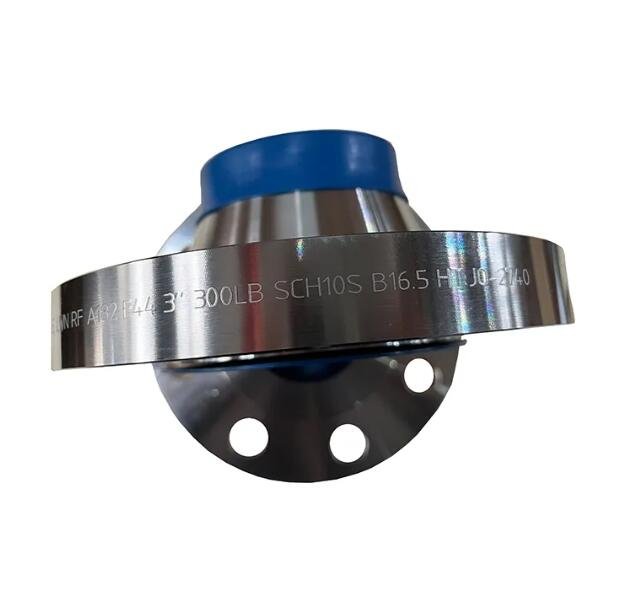
For a catalogue reference, buyers may review the site’s raised-face weld neck flange example and compare it with the ASME B16.5 weld-neck product listing. These pages are product references, not substitutes for the project drawing or approved datasheet. For a quotation, send the completed requirements to our Contact Us page.
Frequently asked questions
Can I use the same flange on both sides of a heat exchanger?
Not automatically. The two circuits can have different pressure, temperature, fluid chemistry, pipe size, facing, gasket, and material requirements. Check each nozzle and its mating component separately.
Is a stainless appearance proof of 316L?
No. A polished or bright surface cannot establish grade, heat treatment, or compliance. Use the specified material documentation and PMI or other verification required by the project.
Does Class 300 mean 300 psi at every temperature?
No. ASME rating classes are pressure-temperature designations, not a universal pressure value. The applicable material group, temperature, standard and design code must be checked together.
Why do bore and schedule matter?
A nominal pipe size does not fully define the inside diameter. Wall thickness, schedule, lining and nozzle geometry can affect alignment, flow area and weld preparation.
Which documents should accompany an export order?
Typical packages include the purchase order, approved drawing, dimensional report, material test report, heat-number traceability, inspection records, marking photos, packing list and any agreed certificates. The owner’s document register controls the final list.
Conclusion: specify the joint, not just the flange
A dependable heat-exchanger connection starts with the complete joint: equipment nozzle, mating pipe, flange dimensions, facing, gasket, bolts, material, temperature, inspection, and records. Use ASME and ASTM information as the starting framework, then let the project design and service conditions set the final limits. If you are sourcing stainless steel flanges for a heat exchanger, send the nozzle schedule, drawing, service data, required standard, quantity, and document expectations through our Contact Us page. We can then review the enquiry against the actual application instead of guessing from a photo.
Need a quotation? Include size, standard, rating, facing, bore, grade, quantity, delivery destination, inspection requirements and certificates in your enquiry.
Technical boundary: this article is general information for procurement planning. The responsible engineer, applicable code, equipment manufacturer and local regulations must approve the final selection, calculations, gasket, bolting and installation procedure.