
Most stainless flange enquiries begin with a type, a size and a pressure class. The grade question arrives later, compressed into one line: “304 or 316?” The two grades look identical and share the same bolt circle, but they do not behave the same in service.
What follows is general technical information for buyers and specifying engineers, not a substitute for project engineering. A grade is only correct in the context of the fluid, chloride level, temperature, welding procedure, governing code and required documentation. The final selection should be confirmed against the applicable standard and project specification, and signed off by a qualified engineer.
What Actually Separates 304 from 316
Both are austenitic chromium-nickel stainless steels. Type 304 carries roughly 18% chromium and 8% nickel. Type 316 adds molybdenum, typically in the region of 2-3%, and that addition is what separates them in corrosive service: molybdenum improves resistance to chloride pitting and to several reducing acids, which is why 316 is the default in much chemical, coastal and marine-adjacent work.
304 and 304L are UNS S30400 and S30403, or EN 1.4301 and 1.4307; 316 and 316L are UNS S31600 and S31603, or EN 1.4401 and 1.4404. For forged flanges in high-temperature piping, the wrought grades usually come through ASTM A182/A182M, which covers forged or rolled alloy and stainless steel pipe flanges, fittings and valves up to a maximum piece weight of 10 000 lb (4 540 kg). In that system the order reads F304, F304L, F316 or F316L, not “304” or “316”.
Product form matters as much as chemistry. ASME B16.5, which governs pipe flanges from NPS 1/2 through NPS 24, is limited to flanges and flanged fittings made from cast or forged materials, with blind flanges and certain reducing flanges also permitted from plate. A drawing that says only “stainless steel, 316” leaves the mill, product form and heat treatment open.
304 versus 304L, and 316 versus 316L
The “L” means low carbon: 0.030% maximum against 0.080% for the standard grade. Lower carbon reduces chromium carbide precipitation in the heat-affected zone of a weld, the mechanism behind intergranular corrosion in welded austenitic joints. Mills often dual-certify 304/304L and 316/316L, which can be acceptable where the specification allows it. If the specification calls for F316L, write F316L, and make sure the marking, heat number and certificate agree.
Corrosion: Where 316 Earns Its Place
Chlorides are the usual reason a buyer moves from 304 to 316. A common comparative index is the pitting resistance equivalent number, PREN = %Cr + 3.3 x %Mo + 16 x %N. It ranks alloys; it is not a design value, and it says nothing about crevices, deposits, stagnant zones, surface finish or temperature. Two flanges of the same grade can behave very differently if one sits in a wet crevice and the other sees flowing, aerated product.
That is why “316 is the seawater grade” is dangerous shorthand. Austenitic grades, including 316, remain susceptible to chloride stress corrosion cracking where tensile stress, chloride concentration and temperature combine. In warm chloride service, static seawater, or locations where evaporation concentrates salts, duplex and higher-alloyed grades are commonly evaluated on the actual operating envelope rather than on a grade name.
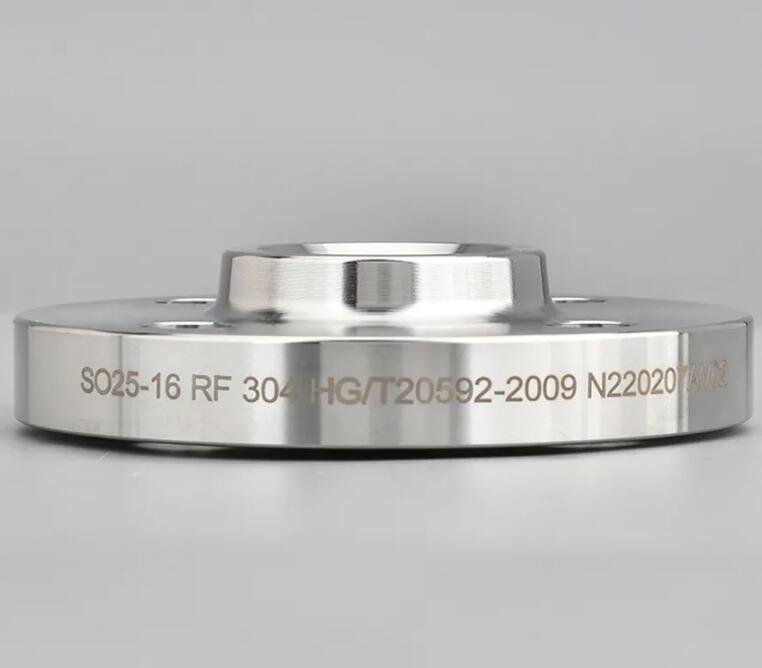
Surface condition belongs in the same conversation. A pickled and passivated surface, free of embedded iron and weld spatter, resists attack far better than a mechanically ground one left contaminated. A 316 flange brushed with a carbon steel wire wheel can corrode like a much cheaper material, and no certificate prevents it.
Strength, Temperature and Welding
Choosing 316 is rarely about strength. In the annealed condition the common austenitic grades are close: ASTM A182 sets a minimum tensile strength of 75 ksi (515 MPa) and minimum yield strength of 30 ksi (205 MPa) for F304 and F316, with the L grades slightly lower. Where more strength is genuinely needed, duplex 2205 (UNS S32205, F51) offers roughly twice the yield strength of the austenitic grades, which can cut wall thickness and weight in high-pressure lines.
Temperature pushes the decision elsewhere. Austenitic grades keep their toughness at low temperature and are widely used in cryogenic service, where L grades are often specified for welded parts and impact testing may be required. At elevated temperature both resist oxidation, but standard-carbon grades risk sensitisation after long exposure in the critical range, which is one reason L or stabilised grades appear in hot specifications. Duplex grades have upper temperature limits well below the austenitic family, so confirm the limit before using one in a hot section.
Welding is where grade and procedure meet. Dissimilar joints, filler selection, heat input and interpass temperature affect the finished joint more than the flange certificate does. Duplex in particular needs a qualified procedure and controlled heat input to keep the ferrite-austenite balance.
304 vs 316 vs Duplex: A Practical Comparison
| Grade and designation | Where it commonly fits | What to watch |
|---|---|---|
| 304 / 304L S30400 / S30403 F304 / F304L |
Process water, mildly corrosive chemicals, food contact surfaces, structural work | Limited chloride tolerance; specify L for welded joints where intergranular corrosion matters |
| 316 / 316L S31600 / S31603 F316 / F316L |
Chloride-bearing streams, coastal atmospheres, pulp and paper, dye and pharmaceutical equipment | Not immune to chloride stress corrosion cracking or crevice attack; check concentration and temperature |
| 2205 duplex S32205 F51 |
Higher-chloride cooling water, heat exchangers, desalination and offshore piping where 316 is marginal | About twice the yield strength, but welding needs a qualified procedure and temperature limits apply |
| 2507 super duplex S32750 F53 |
Aggressive chloride and seawater systems, high-strength small-bore piping, topside lines | Higher alloy content; plan welding consumables, fabrication control and availability early |
The table starts a conversation; it does not make the selection. Grade choice depends on design conditions and the governing piping specification, and should be confirmed by the responsible engineer.
Specification Checklist for a Flange Enquiry
Most grade disputes trace back to an incomplete enquiry. Including the following removes most of the ambiguity:
- Service fluid, concentration, pH, and whether chlorides are present
- Design pressure and temperature, including upset and shutdown conditions
- Flange type, size in NPS or DN, pressure class, and facing (RF, FF or RTJ)
- Governing dimensional standard and edition, such as ASME B16.5, EN 1092-1 or JIS B2220
- Material grade with its product specification and UNS number, for example ASTM A182 F316L rather than “SS316”
- Product form: forged, cast or plate, where the standard restricts plate construction
- Welding and any post-weld heat treatment requirement
- Impact testing, hardness limits or sour service requirements under the applicable specification
- Surface finish, pickling and passivation, and any protective coating
- Inspection: dimensional, visual, non-destructive examination, positive material identification, and third-party witness
- Documentation: material certificate to EN 10204 3.1 or equivalent, with heat numbers traceable to the marking
- Marking, packing, destination and required delivery date
Where Grade Selection Goes Wrong
“SS316” on a drawing. That is a family name, not a purchase description. It does not say whether the part is forged or cast, standard carbon or L, or which specification applies. The gap is usually filled by whoever quotes cheapest.
Buying the grade and forgetting the joint. Flange, gasket, bolting, pipe and weld consumable form one system. A 316 flange welded to 304 pipe with the wrong filler, or bolted with low-alloy studs in a wet chloride environment, gives away much of what the upgrade was meant to buy.
Treating 316 as a universal answer to chlorides. It raises the threshold; it does not remove the cracking mechanism. Where temperature and chloride level are demanding, evaluate duplex or a higher alloy rather than buying 316 twice.
Assuming grade changes the rating. Pressure-temperature ratings come from the dimensional standard and the material group, not from the alloy. A 316 flange in Class 150 is still a Class 150 flange.
Frequently Asked Questions
Is 316 always better than 304?
No. It resists chlorides and some reducing acids better, but costs more and offers no advantage where 304 is adequate. In some environments neither grade is sufficient, and a duplex or higher-alloyed material is the right answer.
Can I use a 316 flange with a 304 pipe?
It is done, but it is a welding and specification decision rather than a purchasing one. Filler metal, welding procedure and project specification all have a say, and the responsible engineer should confirm the combination before ordering.
Do I need the L grade?
The L grades limit carbon to 0.030% and are commonly specified where welded joints will see corrosive service, because they reduce the risk of intergranular corrosion in the heat-affected zone.
Is 316 suitable for seawater?
Not as a blanket rule. Static seawater, crevices, deposits and warm temperatures are demanding for austenitic grades, which can suffer pitting, crevice attack and stress corrosion cracking. Duplex and higher-alloyed grades are commonly evaluated for seawater duty.
Does a higher grade mean a higher pressure rating?
No. The rating comes from the dimensional standard, the pressure class and the material group’s pressure-temperature ratings. Moving from 304 to 316 does not change the class or the dimensions of the joint.
Conclusion
The grade decision is easier once it is framed as a service question rather than a price question. Start with the fluid, the chloride level, the temperature and the welding route, then let the material follow. 304 covers much benign process and structural work, 316 is the sensible step up where chlorides or reducing acids are present, and where 316 is marginal, duplex grades deserve an early look.
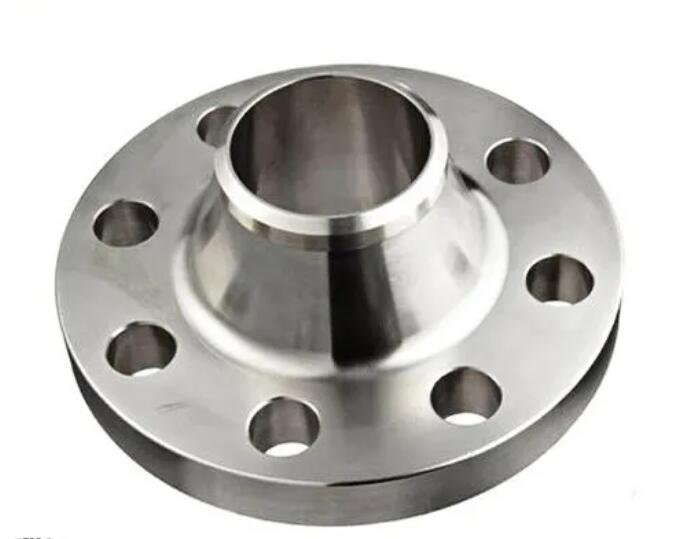
Whatever the shortlist, the final selection belongs with the applicable standard, the project specification and a qualified engineer, and the delivered flange should be verifiable through marking, certificate and, where specified, material identification. Our 316/316L flange range and 304/316 weld neck flange range cover the common austenitic options, and the 2205 duplex weld neck flange shows the next step up in chloride resistance.
If you are still deciding, send the service conditions, size, class, facing and the specification you are working to through our contact page. We will quote against the grade and documentation your project requires, and flag anything in the enquiry that needs clarification before manufacture.
Sources
ASME. B16.5 – Pipe Flanges and Flanged Fittings: NPS 1/2 through NPS 24. Accessed 2026.
ASTM International. A182/A182M – Forged or Rolled Alloy and Stainless Steel Pipe Flanges, Forged Fittings, and Valves and Parts for High-Temperature Service. Accessed 2026.
British Stainless Steel Association. 50 Grades of Stainless Steel – grade designations and compositions. Technical reference, accessed 2026.