
A DN 100 flange ordered as “Class 150” and a DN 100 flange ordered as “PN 16” look like the same part in a photograph. Put them face to face and the bolt holes do not line up. That mismatch is one of the most expensive misunderstandings in flange procurement, and it repeats because both designations sound like pressure ratings.
ASME B16.5 and EN 1092-1 are complete, self-consistent systems, each with its own size range, ratings, dimensions, facings, materials and documentation. This guide compares them where a purchase order is decided. It is general technical information: the governing edition, the project specification and a qualified engineer decide the final selection.
Why the two systems cannot be mixed
Interchangeability needs four things to agree at once: rating basis, dimensions, facing geometry and bolting. The two standards agree on none of them by default.
- Ratings: ASME uses class numbers (150, 300, 400, 600, 900, 1500, 2500); EN uses PN numbers (2.5 to 400).
- Dimensions: outside diameter, thickness and bolt circle are tabulated separately and differ for most size pairs.
- Bolt holes: B16.5 fixes bolt and hole diameters in inch units even in its metric tables; EN 1092-1 uses metric bolting.
- Facings: ASME raised face, flat face and ring joint against EN forms A to H, with different heights and diameters.
A mixed pair cannot be bolted together, and re-drilling is not a correction: opening the holes removes load-bearing area, and no standard covers the result. Keep one system through a line, or plan an adaptor spool with one flange from each system.
Scope: what each standard covers
| Parameter | ASME B16.5 | EN 1092-1 |
|---|---|---|
| Size range | NPS 1/2 to NPS 24 | DN 10 to DN 4000 |
| Rating series | Class 150 to 2500 | PN 2.5 to PN 400 |
| Top class size limit | Class 2500 only to NPS 12 | Limits set by DN tables |
| Construction | Cast or forged; plate only for blind and certain reducing flanges | Includes plate flanges for welding (Type 01) |
| Facing terms | RF, FF, RTJ | Forms A to H |
| Bolting units | Inch | Metric |
Above NPS 24, ASME moves to B16.47, so a 36-inch flange is no longer a B16.5 part despite using the same class numbers. EN 1092-1 covers DN 10 to DN 4000 in one document, which is why very large European pipework is specified in PN terms.
One structural difference matters to buyers: B16.5 limits plate material to blind and certain reducing flanges, while EN 1092-1 standardises the plate flange for welding as Type 01.
Class and PN are not the same number
Neither designation is a working pressure. Class 150 does not mean 150 psi, and PN 16 does not mean a flange is good for 16 bar at every temperature. ISO 7268 defines PN as “a numerical designation which is a convenient round number for reference purposes”, and requires that equipment of the same DN and PN has compatible mating dimensions. PN provides dimensional discipline, not a pressure guarantee.
ISO 7268 also gives a reference correspondence between the series, useful for orientation and dangerous as a buying rule:
| ASME class | Reference PN |
|---|---|
| Class 150 | PN 20 |
| Class 300 | PN 50 |
| Class 400 | PN 64 |
| Class 600 | PN 100 |
| Class 900 | PN 150 |
| Class 1500 | PN 250 |
| Class 2500 | PN 420 |
The correspondence is nominal only: it does not make a Class 150 flange a substitute for a PN 20 flange, and it does not make their allowable pressures identical at temperature. Ratings come from the tables, by class or PN, material group and temperature.
Where the dimensions diverge
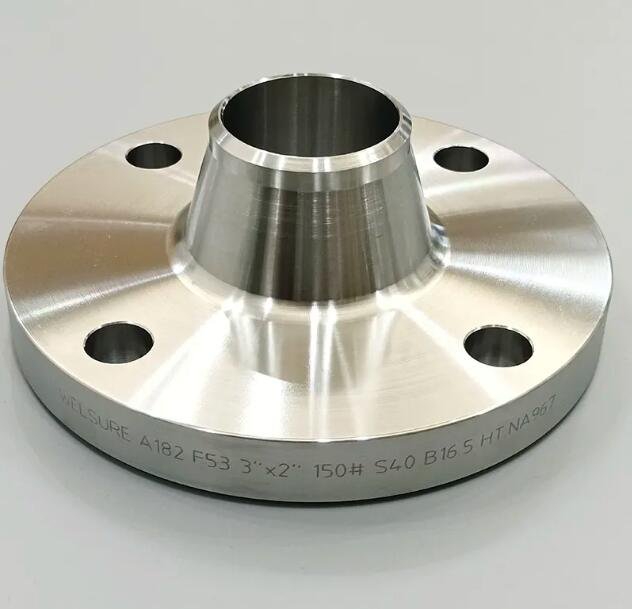
For the same nominal size, the two standards tabulate different outside diameters, thicknesses and bolt circles. Two patterns cause most site problems:
- Bolt circle. Even where hole counts match, the pitch circle usually does not, so the flanges cannot be rotated into alignment.
- Hole diameter. B16.5 hole sizes follow inch bolting, EN hole sizes follow metric bolting. A 5/8 inch hole and an 18 mm hole look similar and will not accept the same stud without play.
Planning a transition between systems
Where a European package meets an ASME line, the transition belongs in the piping design, not the warehouse. The usual answer is a short spool: an EN flange on one end, an ASME flange on the other, both sized to the pipe schedule. Decide this at the drawing stage, because once the pipe is cut there is no compliant way to bridge the gap.
Facings: the same idea, different geometry
| Function | ASME B16.5 | EN 1092-1 |
|---|---|---|
| Gasketed raised face | RF, commonly 1.6 mm high at Class 150 and 300 | Form B, with B1 and B2 variants |
| Full flat contact | FF | Form A |
| Metal ring seal | RTJ groove to B16.20 rings | Forms G and H, PN 10 to PN 40 |
| Tongue and groove | Not a B16.5 facing | Forms C and D |
| Spigot and recess | Not a B16.5 facing | Forms E and F |
Finish follows the gasket, not habit. B16.5 specifies a serrated or smooth finish for raised and flat faces, with a stock finish commonly in the 125 to 500 microinch (3.2 to 12.5 micron) Ra range. EN 1092-1 tightens requirements as PN rises, which is why high-PN European flanges are often ordered to a finer turned finish. In both systems, the gasket supplier decides acceptance.
Materials: ASTM grades against EN designations
The alloys are often the same; the names are not. Forged stainless flanges to B16.5 are usually certified to ASTM A182/A182M, while EN 1092-1 materials use European steel names and numbers, commonly under EN 10222-2.
| Common grade | ASTM | EN |
|---|---|---|
| 304 | F304 | 1.4301 |
| 304L | F304L | 1.4307 |
| 316 | F316 | 1.4401 |
| 316L | F316L | 1.4404 |
| 321 | F321 | 1.4541 |
| Duplex 2205 | F51 / S32205 | 1.4462 |
Carbon steel follows the same pattern: ASTM A105 on the ASME side, P245GH or P250GH on the EN side, with A350 LF2 for low-temperature ASME service.
Dual certification and the L-grade trap
Dual certification is legitimate when one heat genuinely satisfies both specifications and the certificate states both designations. It is not legitimate to relabel a 316 flange as 1.4404 or a 304 flange as 1.4307 because the chemistry looks close. The L grades carry a carbon limit the standard grades do not, and a certificate without carbon does not prove an L grade.
Two substitutions cause trouble in European orders: 1.4571 is titanium-stabilised 316Ti, not 316L, and 1.4541 is stabilised 321, not 304L. Neither is a drop-in replacement for the unstabilised grade on the datasheet.
Marking, certificates and traceability
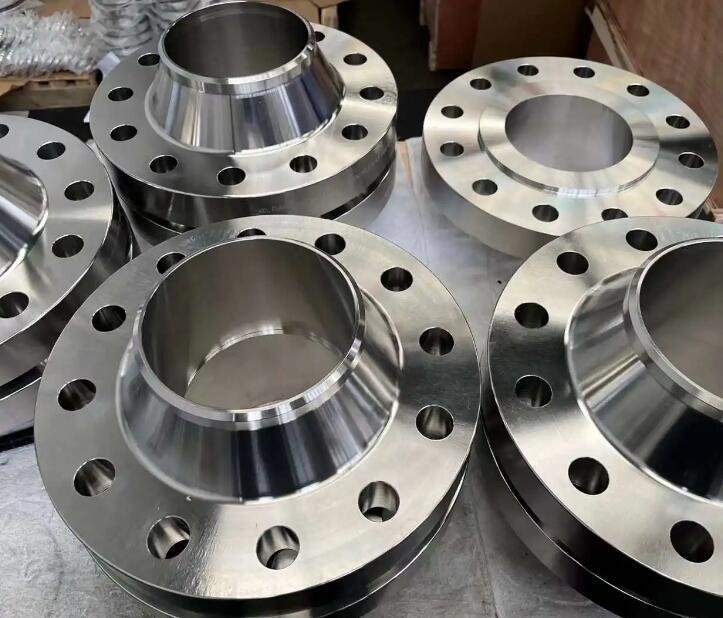
B16.5 requires marking with manufacturer, material designation, class, size and facing. EN 1092-1 marking carries the standard number, DN, PN, flange type, material and manufacturer. Heat traceability normally comes through the certificate, which is the document a buyer relies on.
ASTM A961/A961M sets common requirements across the ASME flange specifications and states that additional requirements bind the supplier only when they appear in the order. In Europe, EN 10204 type 3.1 is the usual baseline for pressure-retaining forgings, with type 3.2 where a third party is required. Neither certificate transfers by translation: the material must satisfy the grade named.
What to put in the RFQ
Most cross-standard problems are created at the enquiry stage. These eight items remove the ambiguity:
- System and edition: ASME B16.5 or EN 1092-1, with the edition the project is designed to.
- Size: NPS with pipe schedule, or DN, never a bare “100 mm”.
- Rating and type: class or PN, plus weld neck, slip-on, blind, plate or threaded, or the EN type number.
- Facing and finish: RF, FF or RTJ, or the EN form letter, with the gasket’s surface requirement where it applies.
- Material: ASTM grade or EN designation, plus any dual-certification requirement.
- Bore and schedule: for weld neck and slip-on types, so the bore matches the pipe wall.
- Inspection and documents: certificate type, marking photographs, PMI or NDE if required.
- Marking and packing: heat traceability and protection of the sealing face.
Frequently asked questions
Can a Class 150 flange be bolted to a PN 16 flange?
Not as a compliant joint. Bolt circle, hole diameter and facing dimensions come from separate tables, so the parts generally will not align, and a forced alignment leaves a joint outside both specifications. Use an adaptor spool or keep one system through the line.
Is PN 16 the same as 16 bar?
No. PN is a nominal designation for reference and dimensional compatibility. Allowable pressure depends on material group and temperature, read from the EN 1092-1 rating tables, which may limit a PN 16 flange well below 16 bar when hot.
Is Class 150 equal to 150 psi?
No. Class 150 in ASTM A105 carbon steel is rated at about 19.6 bar (285 psi) at ambient, less as temperature rises. The class number identifies a rating series; the value comes from the B16.5 tables.
Which standard should a European project specify?
EN 1092-1 is the natural choice for European pipework, covering DN 10 to DN 4000 and aligning with European material and gasket standards. Where a line ties into an ASME-designed package, specify B16.5 and plan the transition deliberately.
Can a supplier certify an A182 F316L flange as 1.4404?
Only if the material and documentation satisfy both specifications and the certificate states both designations. Dual certification is a claim about chemistry and properties, not about names that sound equivalent.
Conclusion
Both standards are mature and well tabulated; neither is better. The risk sits in the handover: a class number read as a pressure, a PN read as a bar rating, a bolt circle assumed to match, a 1.4571 certificate accepted against a 316L requirement.
Name the system, the standard number and the edition in every enquiry, then let the rating tables, facing dimensions and certificates do the rest. Where a project mixes both systems, resolve the transition on the drawing, and have the final selection confirmed against the applicable standard, the project specification and a qualified engineer.
Need stainless flanges to either system with matching documentation? Send the standard, size, rating, facing and grade through our contact page and our team will confirm what can be supplied and certified. You can also review the weld neck flange range, the plate flange range used for EN 1092-1 Type 01 style connections, or a B16.5 weld neck flange in F904L for high-alloy service.
References
ASME. B16.5 – Pipe Flanges and Flanged Fittings: NPS 1/2 through NPS 24, Metric/Inch Standard.
ASTM International. ASTM A182/A182M – Forged or Rolled Alloy and Stainless Steel Pipe Flanges, Forged Fittings, and Valves and Parts for High-Temperature Service.
ISO. ISO 7268 – Pipe components: Definition of nominal pressure.