
A blind flange has no bore. The face is solid, and its only job is to close an opening: the end of a line, a vessel nozzle, a valve port, or a spare connection that may be used later.
That simplicity hides decisions. Facing, material, thickness, gasket and bolting all have to match the mating flange, and a blind flange is not always right when the drawing calls for a line blank such as a spectacle blind or a spade. Above all, a blind flange is dimensionally standard but functionally project-specific: confirm the final selection against the applicable standard, the project specification, and with a qualified engineer.
What Is a Blind Flange
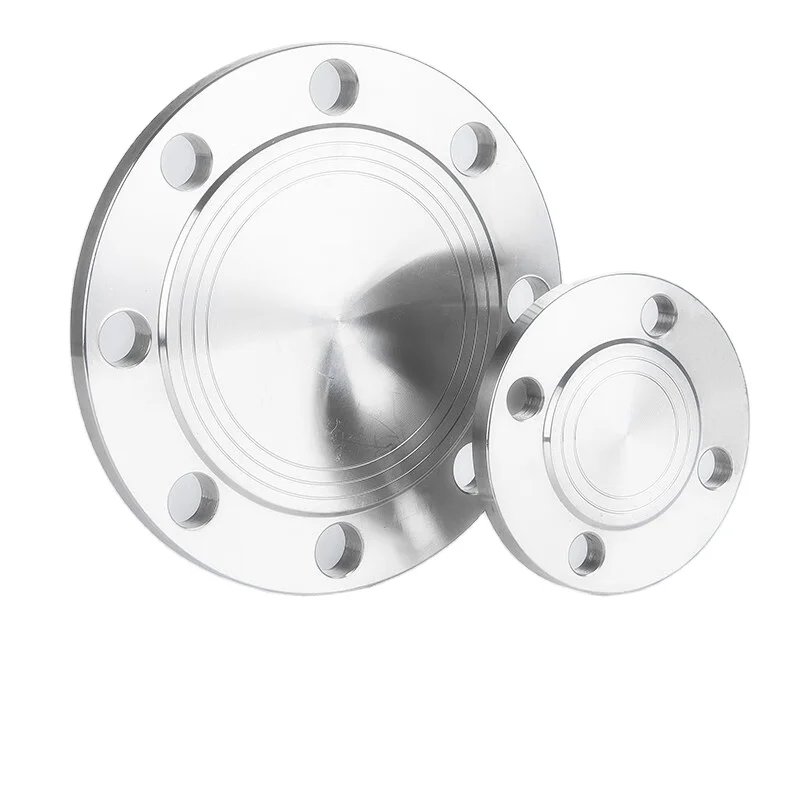
A blind flange, abbreviated BL, is a circular flange with a full face and no central opening. Its bolt holes match the mating flange, and the joint is sealed with the same gasket that would serve a through flange of the same size, class and facing.
Because there is no bore, it is not welded to a pipe. It bolts onto an existing flange face, and pressure is held by the plate together with the bolted, gasketed joint. The plate is the load-carrying element, which is why a blind flange in a given size and class is normally thicker and heavier than a weld neck or slip-on flange of the same rating. It closes a header end or branch, blanks a spare nozzle, or isolates a section for maintenance.
Blind Flange Types and Related Line Blanks
Not every item called a blind on a drawing is a blind flange. Three look similar in a bill of materials and behave differently in service.
Blind flange (BL)
A round plate with a bolt circle and no bore, bolted in place with no open position. To open the line, the joint must be broken and the flange removed. It suits closures that are effectively permanent or only occasionally accessed.
Spectacle blind (figure-8 blind)
One assembly of two discs joined by a web: one solid, the other an open ring sized to the pipe bore. Rotated within the joint between two flanges, it changes the line from blanked to open and back, which makes it common where a line must be positively isolated and then returned to service.
Spade, spacer and paddle blind
A spade, or paddle blind, is a solid disc with a handle tab, often used for isolation during shutdowns and for test blanks. A spacer is an open ring of matching thickness and bolt circle, fitted opposite a spade so the joint can be made up in either position. Spectacle blinds, spades and spacers are dimensional line blanks rather than flanges, specified under ASME B16.48, which covers line blanks in sizes NPS 1/2 through NPS 24 for installation between ASME B16.5 flanges in the 150, 300, 600, 900, 1500 and 2500 pressure classes.

Blind Flange Facings: RF, FF and RTJ
The facing is the machined surface that seats the gasket, and it has to match the component the blind bolts against.
- Raised face (RF). A shallow raised annulus that concentrates bolt load on a smaller area, making it the most common facing in process piping.
- Flat face (FF). A plain face with no raised annulus, used with a full-face gasket and often paired with flat-faced equipment. An RF flange and an FF flange should not be bolted together.
- Ring joint (RTJ). A machined groove taking a metal ring gasket, with a matching groove on the mating component, chosen for demanding pressure and temperature duty.
Facings also carry a surface finish that has to suit the gasket type. State the facing and finish you need, and the facing of the flange the blind will bolt against, so that the faces, the gasket and the bolting are consistent.
How Blind Flanges Are Made: Forged and Plate Construction
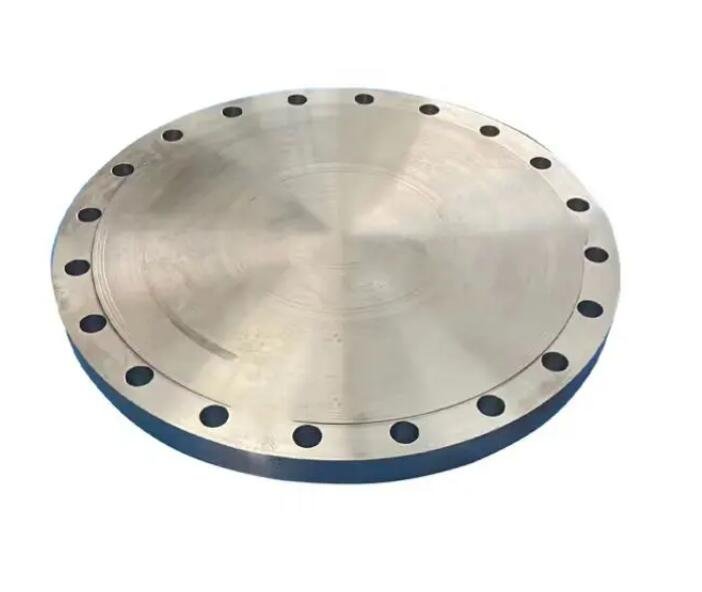
Blind flanges are one of the few flange types that may legitimately be produced from plate as well as from forgings and castings: ASME B16.5 states that the standard is limited to flanges and flanged fittings made from cast or forged materials, and that blind flanges may also be made from plate. Forged material to a specification such as ASTM A182/A182M is worked while hot and then heat treated, and that specification covers forged or rolled alloy and stainless steel flanges up to a maximum product weight of 10 000 lb (4 540 kg). Plate construction is cut from plate stock and machined, which can be economical in large sizes.
What matters is not the route itself but whether the delivered flange meets the ordered dimension, rating, material specification and any project requirement. Because no pipe shares the load with a blind flange, grade, heat treatment, impact and hardness requirements should appear explicitly on the order.
Blind Flange Compared with Line Blanks
| Item | How it is fitted | To open the line |
|---|---|---|
| Blind flange (BL), no bore | Bolted to the mating flange, with a gasket | Break the joint and remove the flange |
| Spectacle blind, open ring plus solid disc | Between two flanges, on the bolt circle | Rotate the assembly within the joint |
| Spade or paddle blind, solid disc | Between two flanges | Break the joint and withdraw the spade |
| Spacer, open ring | Opposite a spade, in the same joint | Not needed; it holds the gap |
Use the table to identify the correct item, not to select one. Whether a blind, a spectacle blind or a spade is acceptable in a given location is a decision for the piping design and the governing code.
Standards and Documentation
- Dimensions and ratings: ASME B16.5 covers pipe flanges and flanged fittings from NPS 1/2 through NPS 24, including blind flanges, in rating classes 150 through 2500 depending on size. Above NPS 24, ASME B16.47 applies, in Series A and Series B.
- Line blanks: ASME B16.48 covers spectacle blinds, spades and spacers in sizes NPS 1/2 through NPS 24 for use between B16.5 flanges.
- Material: ASTM A182/A182M for forged or rolled alloy and stainless steel components; separate specifications apply to carbon steel and other product forms.
- Project add-ons: marking, certificates and inspection documents, non-destructive examination, positive material identification, impact testing and hardness limits are usually set by the owner specification rather than the dimensional standard, and must be requested.
Blind Flange Inquiry Checklist
Most quotation delays come from missing facing, material or documentation detail rather than from the flange itself. Include the following:
- Item: blind flange, or line blank (spectacle, spade or spacer)
- Size: NPS or DN, and pressure class
- Standard and edition that governs the rating, including the series for large diameters
- Facing and surface finish: RF, FF or RTJ, and the facing of the mating flange
- Material grade and specification, plus any corrosion allowance
- Quantity, including spares
- Whether gaskets, bolting and a spacer should be quoted as well
- Inspection and testing: non-destructive examination, positive material identification, and any test required by the specification
- Documentation: material certificates and inspection documents, such as EN 10204 3.1 or 3.1B where the project calls for them
- Marking, surface protection or coating, packing, delivery location and required date
Practical Selection Notes
Three points recur on live projects. Facings must match: a raised face blind will not seal against a flat face flange, and a ring joint blind needs a matching groove rather than a plain face. A blanked line is still a pressure boundary, so gasket, bolting and tightening deserve the same attention as any other joint. Weight also matters: the thicker plate of a large blind raises lifting and support questions. Where a size, rating or material falls outside the standard range, treat it as an engineered item and have the design confirmed.
Our blind flange range shows the configurations we produce, including a large-diameter raised face blind to ASME B16.47A and a listed spectacle blind flange.
Frequently Asked Questions
What is the difference between a blind flange and a spectacle blind?
A blind flange is a single solid plate bolted to one flange face, with no open position. A spectacle blind is a two-disc assembly fitted between two flanges, opened or blanked by rotating it within the joint.
Does a blind flange need a gasket?
Yes. In normal service it is sealed by a gasket, exactly as a through flange is. The gasket type has to suit the facing, the surface finish, the fluid and the design conditions.
Which standard covers blind flanges above 24 inches?
ASME B16.5 is limited to NPS 1/2 through NPS 24. For larger sizes ASME B16.47 applies, in Series A and Series B. Because the series are not interchangeable in a joint, state the series and edition on the order.
Can a raised face blind flange be bolted to a flat face flange?
No. Raised face and flat face are different seating arrangements and are not designed to be mated. Confirm the facing on both sides of the joint, and the gasket type, before ordering.
Can a blind flange isolate a line permanently?
It is commonly used where a closure is effectively permanent, such as a spare nozzle or a capped branch. Whether it suits a long-term isolation duty depends on the design conditions, the isolation philosophy and the governing code.
Conclusion
A blind flange looks like the most straightforward item on a piping bill of materials, and dimensionally it usually is. The difficulty sits around it: matching the facing, choosing between a blind and a line blank, stating material and specification precisely, and covering the inspection and documentation requirements the dimensional standard omits.
Work through item type, size, class, facing, material, standard and documentation in that order, and the quotation you receive will be the one you can install. Where the closure has to be opened and closed in service, look at a spectacle blind or a spade and spacer arrangement instead of forcing a blind flange into a duty it was not designed for. To discuss a requirement, send the details from the checklist above through our contact page.
Reference
ASME. B16.5 – Pipe Flanges and Flanged Fittings, NPS 1/2 through NPS 24. Official standard page, accessed 2026.
ASME. B16.48 – Line Blanks. Official standard page, accessed 2026.
ASTM International. A182/A182M – Forged or Rolled Alloy and Stainless Steel Pipe Flanges. Official standard page, accessed 2026.