

Machined stainless steel flanges: a bright surface is not the same as a passive one.
A forged and machined stainless steel flange leaves the shop bright and apparently clean. Six weeks later the same flange can show brown bloom around the bolt holes, rust streaks in the bore, or a dull patch where a lifting chain touched it. The alloy has not changed. The surface has.
Corrosion resistance in stainless steel comes from a thin, chromium-rich oxide film that forms on a clean surface and re-forms when damaged. That film cannot form over scale, heat tint, embedded iron or machining residue. Pickling and passivation remove those barriers, and they are routinely confused with each other, with cleaning and with polishing.
Why a New Stainless Flange Can Rust
Austenitic grades such as 304 and 316L depend on a passive film a few nanometres thick. The British Stainless Steel Association notes that this film forms spontaneously wherever a clean surface meets oxygen, and that stainless steel is defined by a minimum of 10.5 percent chromium (BS EN 10088-1).
What buyers actually see is usually not the alloy corroding through, but free iron sitting on top of it. Carbon steel particles from tooling, racks, chains or blasting media become embedded in the softer stainless surface, oxidise, and stain the area around them. The metal underneath may be sound, yet the delivery looks defective, and in chloride service those sites can start pitting.
A second problem is chromium depletion. During forging, heat treatment or welding, chromium migrates to the surface to form oxide, so the layer just below the oxide is lower in chromium than the bulk metal and correspondingly less corrosion resistant. That is why heat tint must be removed rather than merely cleaned.
Pickling, Passivation and Descaling Are Different Jobs
The Euro Inox guide Pickling and Passivating Stainless Steel sets out the distinction: descaling removes thick visible oxide, pickling removes a thin metal layer together with the chromium-depleted surface, and passivation removes free iron and promotes the passive film without removing metal.
| Treatment | What it does | When to specify it |
|---|---|---|
| Pickling | Nitric/hydrofluoric acid removes a thin metal layer, heat tint, scale and embedded iron; leaves a uniform matt grey | After welding or heat treatment, wherever heat tint and embedded contamination exist |
| Nitric passivation | Removes free iron and accelerates the passive film; removes no metal | Machined parts with clean but possibly iron-contaminated surfaces |
| Citric passivation | Same purpose with less hazardous chemistry; covered by ASTM A967 | Where nitric acid is restricted or the specification allows citric treatment |
| Electropolishing | Electrochemical removal of surface metal; brightens and levels | Hygienic or high-purity service needing a defined Ra and appearance |
Two consequences follow. Nitric acid alone passivates but does not pickle effectively, so it will not remove heat tint. And passivation cannot rescue a scaled surface: the standards require a clean, scale-free surface before passivation means anything.
Where Iron Contamination Comes From
The manufacturing route sets the starting point: a plate flange carries a mill surface across its faces, while a forged weld neck flange is machined all over. Neither is immune, because most contamination is introduced by handling:
- Carbon steel slings, chains and forklift forks used to move forgings.
- Grinding, brushing or blasting with abrasives previously used on carbon steel.
- Wire brushes with carbon steel bristles on threads or faces.
- Machining or storage in a mixed-metal shop without segregation.
- Acid or rinse water trapped in crevices and between stacked flanges.
- Pallets, cardboard and workshop dust holding moisture in transit.

Flanges stacked in a workshop. Storage and handling around carbon steel are common sources of embedded iron.
Because the contamination is superficial it can be removed, but it must be removed chemically or by a controlled acid stage. Single-stage abrasive cleaning such as wire brushing tends to spread iron rather than eliminate it.
What ASTM A380, ASTM A967 and EN 2516 Require
Three documents carry most of the contractual weight. ASTM A380/A380M is a practice for cleaning, descaling and passivation, and it is explicit that the word passivation carries several meanings; the purchaser is expected to say which one is intended. ASTM A967/A967M specifies chemical passivation treatments – nitric immersion, citric immersion and electrochemical – with rinsing and visual acceptance criteria. EN 2516 covers passivation of corrosion-resisting steels by process class.
ASTM A967 also defines the tests that confirm the treatment worked. A supplier certificate should reference one of them rather than simply asserting that parts were passivated.
| Test (ASTM A967) | What it indicates | Typical use |
|---|---|---|
| A – water immersion | Rust from residual surface iron | General machined parts |
| B – high humidity | Free iron revealed by humid exposure | Humid or coastal service |
| C – salt spray | Behaviour under chloride exposure | Marine and offshore orders |
| D – copper sulfate | Free iron, shown by copper plating out | Quick shop-floor check |
| E – ferricyanide | Free iron as blue coloration (ferroxyl test) | Critical surfaces |
| F, G – damp cloth, boiling water | Residual iron on finished parts | Final inspection before packing |
ASTM A380 adds acceptance methods for cleanness, including visual inspection, wipe tests, the water-break test and free-iron tests. These are not pass or fail criteria on their own; they are agreed between purchaser and supplier, which is precisely why the inquiry has to mention them.
How to Specify It in a Flange Inquiry
These points complement the commercial details in our stainless steel flange inquiry guide:
- Grade and product standard. State the material specification, for example ASTM A182 F316L or F51, with the dimensional standard and pressure class. Surface treatment never overrides the grade requirement.
- Treatment route. Pickling followed by passivation, or passivation only. If passivation only, confirm that no tint or scale will be present.
- Acid system. Nitric or citric, and whether either is excluded by site rules.
- Surfaces in scope. Raised face, back face, bore, neck and any machined groove. A flange pickled outside but left untreated in the bore is a common complaint.
- Sequence against final machining. Pickling changes surface texture, so agree whether faces are machined before or after treatment and confirm the finish afterwards.
- Acceptance test and sampling. Name the ASTM A967 practice and the sampling basis per lot instead of relying on visual inspection alone.
- Rinsing, drying and packing. Chloride-free final rinse, thorough drying, and packing that keeps moisture off the surface.
- Documentation. Ask for a treatment record and test result, and keep it distinct from third-party certification.
What Treatment Does to Faces and Dimensions
Pickling removes metal, though only a thin surface layer. It is not a sizing operation and cannot correct a machining tolerance, but it does alter surface texture, which matters on a gasket seating face. Where the drawing calls for a face finish under the applicable flange standard, that finish must be verified after treatment, not before.
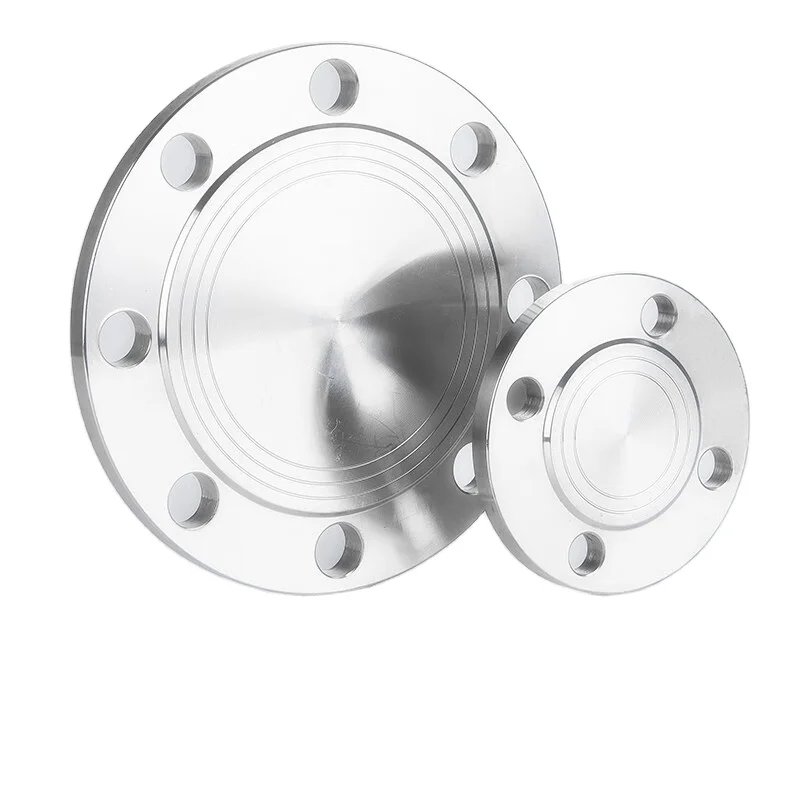
Machined flanges with concentric face grooves. Treatment has to reach the bore and back face, not only the visible face.
The usual safe arrangement is to agree the sequence in writing: rough machine, pickle and passivate, then finish machine the gasket face if a controlled texture is required. On ring type joint flanges the groove needs particular attention, since acid can be retained there and the profile is a sealing dimension.
Acceptance Problems and What They Mean
- Patchy grey. Oil or shop soil was present before pickling, so the acid acted unevenly.
- Brown bloom after weeks in store. Free iron remains, or parts were recontaminated during packing.
- Rust in the bore or bolt holes only. Acid or rinse water was trapped.
- Dark staining near a weld. Heat tint was not removed; passivation alone will not shift it.
- White chalky residue. Incomplete rinsing or hard-water deposits from the final rinse.
Frequently Asked Questions
Is passivation necessary on every stainless flange?
No. Properly handled mill material is already passive, and the Euro Inox guidance treats acid passivation as the exception rather than the rule. It matters for machined parts with restricted oxygen access, for parts that may have picked up iron, and wherever the purchaser’s specification demands a defined surface condition.
Does pickling change flange dimensions?
It removes a thin layer of metal, so it is not dimensionally neutral, but it is not a sizing process and cannot correct thickness or bore tolerance. The practical risk is to surface texture and closely toleranced sealing features, which is why the machining sequence should be agreed first.
Citric or nitric acid passivation?
Both appear in ASTM A967 and both target free iron while supporting the passive film. Nitric is the traditional route; citric avoids nitric fumes and is easier to handle on site. Which one is acceptable often depends on the end user’s specification, so state a preference or state that either will do.
Can passivation remove weld heat tint?
Not reliably. Heat tint is a chromium-depleted oxide layer, and removing it needs pickling or mechanical removal followed by an acid stage. On a weld neck flange, the neck-to-pipe weld is exactly where this matters.
How do I confirm the treatment worked?
Agree an ASTM A967 practice with the supplier and ask for the result. Copper sulfate and ferricyanide tests are the practical shop-floor checks for free iron; water immersion, humidity and salt spray take longer but reflect service more closely. Visual inspection should show a uniform surface with no etching, pitting or frosting.
Conclusion
Pickling and passivation are not decorative extras. They decide whether the corrosion resistance built into a 304, 316L or duplex flange is actually available at the surface. The engineering logic is simple: remove what should not be there and let the alloy do its job. The purchasing logic is equally simple: state the grade, the treatment route, the surfaces in scope, the sequence against machining and the acceptance test, and the order becomes verifiable.
Treat this as general technical information rather than a project specification. Final selection of grade, treatment and acceptance criteria depends on the applicable standard, the service environment, the project specification and confirmation by qualified engineering personnel.
If you are sourcing stainless steel flanges with a defined surface condition on faces, bore and neck, send your drawing, quantity and treatment requirement. Our team will quote against that specification rather than a catalogue description.
Request a quotation for pickled and passivated stainless steel flanges