
An RTJ flange seals with metal, not with a soft gasket. Both mating flanges carry a machined ring groove, and a solid metal ring is compressed between them until it yields against the groove flanks. The pressure boundary is steel against steel.
That is why ring type joint facings appear on high-pressure gas, hydrogen, steam and wellhead piping, and why the joint is less forgiving than a raised face: there is no soft gasket to absorb misalignment or a damaged surface.
Final selection must be confirmed against the applicable standard edition, the project specification and a qualified engineer.
What Is an RTJ Flange?
RTJ stands for ring type joint. The facing is marked RTJ on the drawing, and instead of a raised annulus the flange face carries a machined groove: a shallow channel with angled flanks around the bore. Two flanges of the same facing are bolted together with a metal ring seated in both grooves. Bolt load drives the ring into the flanks, the ring yields locally, and the contact band that forms is the seal.
- No raised face. The groove is cut into the face itself, so an RTJ flange cannot be bolted to a raised face flange of the same size.
- The gasket is a machined metal ring with its own standard, dimensions and marking.
- The seal depends on controlled deformation, so hardness, groove geometry and bolt preload matter together.
ASME B16.5 covers RTJ facings from NPS 1/2 to 24 and Class 150 to 2500. Larger sizes fall to ASME B16.47.

How the Ring Joint Seal Works
Groove and ring geometry
R series rings come in two sections. An octagonal ring has flat, angled faces that seat on the groove flanks; an oval ring presents a curved section that contacts nearer the top and bottom. Both fit the same groove and carry a ring number tied to a size and class, which is not a size in millimetres and cannot be read from a photograph.
Groove width, depth and pitch diameter decide whether a ring seats. Too proud and it will not compress; too deep and it will not touch the flanks. Groove gauges, not calipers alone, are normal inspection practice.
Hardness and bolt load
The joint works because the ring is softer than the groove: under load the ring deforms while the groove stays elastic, so the joint can be remade without resurfacing. ASME B16.20 sets hardness limits by ring material, and specifications commonly ask for roughly 30 HB difference. That difference belongs on the mill certificates, not in an assumption drawn from the grade name.
A metal ring does not conform like a soft gasket. Faces must be parallel, the bore aligned, and bolts tightened in stages in a cross pattern to a defined torque; preload is normally higher than for a comparable raised face joint.
RTJ vs Raised Face vs Flat Face
| Point | Raised face and flat face (RF / FF) | Ring type joint (RTJ) |
|---|---|---|
| Sealing element | Soft or semi-metallic gasket compressed by bolt load | Solid metal ring yielded between two machined grooves |
| Face detail | RF has a raised annulus; FF is flat across the bolt circle | Groove cut into the face; no raised annulus |
| Gasket types | Sheet, spiral wound, graphite, PTFE | Metal ring to ASME B16.20 |
| Rating range | All standard classes, general service | Available through the class range; most often specified from Class 600 upward |
| Face finish | Typically 125 to 500 microinch Ra | Fine groove finish, commonly 63 microinch (1.6 micron) Ra class |
| Break and remake | Gasket replaced, surface re-checked | Ring replaced, groove re-inspected |
| Typical service | Water, utility, process, general steam | High-pressure gas, hydrogen, high-temperature steam, wellhead, offshore |
RF and FF joints are gasket-and-surface systems; RTJ is a geometry-and-hardness system. The choice follows from pressure, temperature, fluid, fire exposure and the piping class the project is built to.
The Standards Behind an RTJ Joint
ASME B16.5 and ASME B16.20
B16.5 defines pressure-temperature ratings, materials, dimensions, tolerances, marking and testing for flanges and flanged fittings, and covers bolting, gaskets and joints. It is limited to cast or forged flanges, with plate permitted only for blind and certain reducing flanges: a part cut from plate against a B16.5 drawing is a specification conflict, not a variant.
B16.20 covers metal ring joint, spiral wound and grooved metal gaskets for flanges to B16.5, B16.47, API 6A and ISO 10423. The current edition is B16.20-2023.
R, RX and BX are not interchangeable
R rings serve B16.5 and B16.47 flanges. RX and BX belong to API 6A and 6BX wellhead practice, with different sections and grooves. A wellhead ring in a B16.5 groove is a leak path, not an upgrade.
Material specification and EN 1092-1
Forged stainless flanges are normally certified to ASTM A182/A182M, which covers forged or rolled alloy and stainless flanges up to 10,000 lb (4,540 kg) per piece. A182 and A240 are not interchangeable even when the grade designation matches. EN 1092-1, for its part, sizes by DN and PN and does not define the ASME ring joint facing, so a project mixing PN and RTJ flanges needs an agreed transition detail.
Material and Hardness Selection
On the flange side, 304/304L and 316/316L cover most demand, with 321 and 347 for stabilised grades and duplex, super duplex, 6Mo or nickel alloys where chlorides or strength demand them. On the ring side, soft iron, low carbon steel, 304, 316, F5 and nickel alloys are common; the ring must be corrosion compatible with the process and softer than the groove.
The groove is also a crevice where chlorides concentrate, and pitting there is hard to see and expensive to repair. Material selection is a corrosion-engineering decision driven by fluid, concentration, temperature and environment, to be confirmed by the project’s materials engineer.
Machining, Inspection and Documentation
- Groove dimensions: width, depth and pitch diameter checked with gauges against the standard’s tables.
- Groove surface: fine finish, free of radial scores, chatter, dings and corrosion; damage usually means replacement, not polishing.
- Ring: correct ring number and material code, hardness within the B16.20 limit.
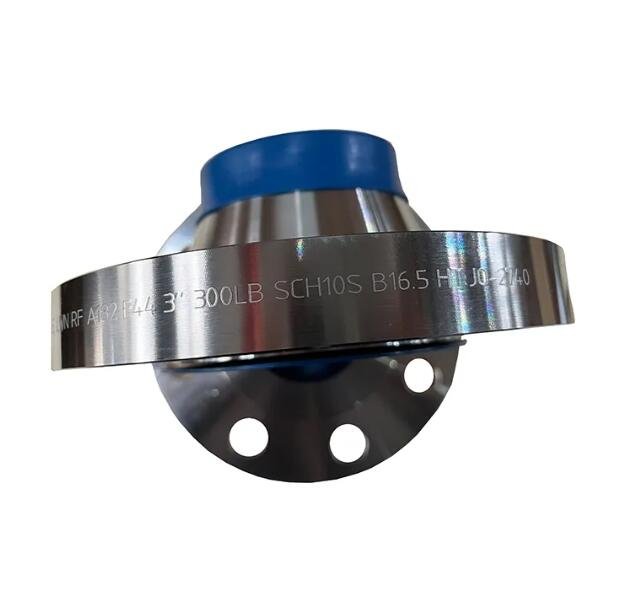
- Marking: flange to B16.5 for size, class and material; ring to B16.20 for ring number and material.
- Documents: EN 10204 type 3.1 certificates, plus PMI and dimensional and hardness reports where specified.
State the certificate type, tests and marking in the enquiry; documentation is rarely retrofittable after shipment.
Installation, Re-Make and Failure Causes
- Inspect both grooves with faces clean and dry; fit a new ring squarely, with no grease on sealing surfaces unless the specification allows it.
- Align the bore and bring the faces parallel before tightening, then torque in stages in a cross pattern.
- On break-out, discard the ring, inspect the grooves and fit a new ring; a yielded ring will not reproduce its contact band.
Most leaks trace to a short list: the wrong ring number, groove damage from prying or unprotected shipping, hardness too close to the groove, a reused ring, uneven bolt load, misalignment, crevice corrosion, and mismatched facings.
RTJ Flange Enquiry Checklist
- Standard and edition: ASME B16.5, B16.47 or the project datasheet.
- Size and class: NPS and Class, with the pipe schedule.
- Flange type: weld neck, blind, slip-on or the type the standard permits with an RTJ facing.
- Facing: RTJ, with the ring number if the project defines it.
- Ring material and the hardness limit to be certified.
- Flange grade and material specification, for example 316L to ASTM A182.
- Groove finish, design pressure, temperature and fluid.
- Inspection and documentation: certificate type, PMI, dimensional and hardness reports.
- Quantity, spares, marking, protection and export packaging.
Frequently Asked Questions
What is the difference between an RTJ flange and a raised face flange?
A raised face flange seals on a soft or semi-metallic gasket compressed against a raised annulus. An RTJ flange has a machined groove instead and seals on a solid metal ring crushed between two grooves. The bolt circle may look similar, but the facing differs and the joints are not interchangeable.
Can an RTJ flange be bolted to a raised face flange?
Not as a sealing pair. One face has a groove and the other a raised annulus, so there is no matching seat for either a ring or a flat gasket. Changing the facing, or using an engineered adapter, is a design decision to confirm against the piping class and with a qualified engineer.
Can a ring joint gasket be reused?
Standard practice is to fit a new ring every time the joint is broken. The ring has yielded into the groove and will not reproduce the same contact band. Any exception is a project decision based on inspection and the governing procedure, not a default.
Are RTJ flanges only for high pressure?
B16.5 includes RTJ facings across its class range, so the facing is not restricted by definition. In practice it is specified where a metal seal is wanted: high pressure, high temperature, hydrogen, fire-exposure duties and wellhead equipment. Suitability for a specific line comes from the piping class and design conditions.
Conclusion
An RTJ joint is simple in principle and unforgiving in detail. Metal against metal removes the gasket’s tolerance for imperfection and moves the burden onto groove geometry, ring hardness, surface condition and bolt load. Get those four right and the joint holds through repeated thermal cycles; get one wrong and the leak appears at the worst moment.
What prevents it is specification work: the correct standard and edition, the correct ring number and material, a flange grade backed by the right certificate, a groove finish stated numerically, and documentation agreed before production. Treat the ring as an engineered component, not an accessory.
Need RTJ flanges for a project? Send the checklist above through our contact page and our team will confirm facing, ring number, grade and documentation against your specification. You can also review the weld neck flange range, the B16.5 weld neck flange offered with RF and RTJ facing, and the blind flange range available with FF, RF and RTJ facing.
References
ASME. B16.5 – Pipe Flanges and Flanged Fittings: NPS 1/2 through NPS 24, Metric/Inch Standard. Official standard page.
ASME. B16.20-2023 – Metallic Gaskets for Pipe Flanges. Official standard page.
ASTM. ASTM A182/A182M-24 – Standard Specification for Forged or Rolled Alloy and Stainless Steel Pipe Flanges, Forged Fittings, and Valves and Parts for High-Temperature Service. Official standard page.