
A spectacle blind is a single steel plate shaped like a figure eight. One eye is a ring that matches the bore; the other is a solid disc. Bolted between two flanges, it lets an operator isolate a line or restore flow by turning the plate over, creating a physical barrier that no valve can imitate.
The purchasing is less simple. A spectacle blind is dimensioned to a standard of its own, needs longer studs than a plain joint, and the market uses several names for parts that are not interchangeable. This guide covers the geometry, what ASME B16.48 fixes and what it leaves to the buyer, material and facing choices, changeover practice and the data an inquiry needs. It is general information: acceptance criteria come from the applicable standard edition, the project specification and a qualified engineer.

What a Spectacle Blind Is, and What It Is Not
A spectacle blind – also called a figure-8 blind, spectacle plate or spectacle flange – is an operational line blank. The plate is one piece: a ring eye and a blind eye joined by a web, with a hole in the web for a lug or tag. It sits between two flanges with a gasket on each face. With the ring eye in the joint, flow passes through; with the blind eye in the joint, the line is blocked.
Three details matter when the part is bought rather than described. Thickness is set by the standard for the size and class, not by the pipe wall. Bolt holes follow the mating flange pattern, so the blank is ordered to the flange standard, not to the pipe outside diameter. Each face is machined for the gaskets on both sides, separately from the plate material.
Spectacle Blind, Spacer and Blind, Paddle Blind, Blind Flange
| Part | How it works and where it is used |
|---|---|
| Spectacle blind (figure-8) | One plate, two eyes. Isolate or restore flow by unbolting and turning it. Used at permanent isolation points that will be operated: battery limits, utility tie-ins, tank nozzles, pump suction and discharge. |
| Spacer and blind (two pieces) | A separate spacer ring and blank disc, each with one eye, handled as a pair. The spacer must match the blank thickness so one set of studs works in either position. |
| Paddle blind (spade) | A single plate with no ring eye, installed only closed so the line cannot pass. Used for one-off isolation, testing, or where no open position is required. |
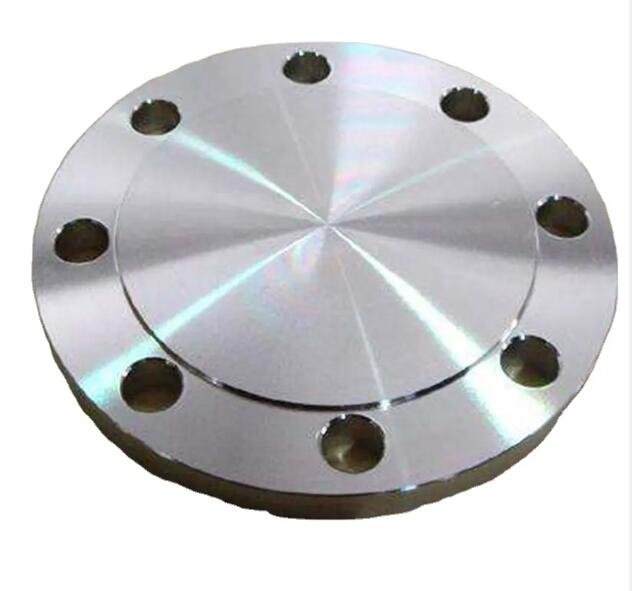
| Blind flange | A bolted cap on a nozzle, vessel opening or line end. Not an in-line device and not designed to be turned: it closes a connection, not an operating line. |
Ask for a blind flange and a supplier will quote a blind flange, not an operating device.
What ASME B16.48 Fixes, and What It Leaves to You
ASME B16.48, Line Blanks, is the reference for operational line blanks. The 2025 edition covers pressure-temperature ratings, materials, dimensions, tolerances, marking and testing, in sizes NPS 1/2 through NPS 24, between ASME B16.5 flanges in Classes 150 to 2500.
The standard fixes the dimensional envelope for each size and class, the thickness table, the bolt hole layout shared with the mating flange, and the marking content. It does not fix your gasket, facing combination, tag numbering or inspection level. Above NPS 24 blanks are drawn for the project, often against a B16.47 series A or B flange, and need engineering input on thickness and rating.
Positive Isolation and the Stud Length Problem
A spectacle blind is chosen for a visible, physical break in the line. A closed valve can pass; a plate cannot. Sites that require positive isolation before entry, hot work or intrusive maintenance specify a blind rather than rely on valve closure, and its position is recorded on the isolation certificate.
The consequence is mechanical. A plain flanged joint takes its stud length from two flanges and one gasket. Insert a blind and the stack becomes two flanges, two gaskets and a plate of tabulated thickness; standard studs are then too short. Length must be calculated from the actual stack and ordered with the blinds, not discovered on site. The same arithmetic governs a spacer and blind pair: a thinner spacer stops the joint closing to the same stack height in both positions.
Material and Facing Choices for Stainless Blanks
Grades and product form
Common choices are ASTM A182 F304 or F304L, F316 or F316L, duplex F51 (2205), super duplex F53 and F55, and high-alloy austenitics such as F904L. Blanks are also produced from plate, so state the product form and grade the certificate will cover: a plate blank to an A240 grade is a different document trail from a forged blank to A182.
Matching the line
The blank should be metallurgically consistent with the flanges and pipe it sits between. A 316L blank in a super duplex spool is a design decision with corrosion and documentation consequences, not a purchasing shortcut. In chloride-bearing, sour or high-temperature service, grade selection belongs with the engineer who wrote the piping specification.
Facing, gasket and finish
Raised face is the default and accepts sheet, spiral wound and filled gaskets; flat face suits full-face gaskets and fragile equipment. Ring joint blanks need more thought, because two grooved flanges normally meet through a single ring, and inserting a blank changes the number of grooves in the stack. Where the blank sits outdoors, in wash-down or hygienic areas, state the finish – pickled and passivated, or a defined sealing-face roughness.
Changeover Practice
- Prove zero energy first. Depressurise, drain and vent, then confirm with a gauge and an open drain. A blind is never turned on a live line.
- Fit new gaskets on both faces. A gasket that has been compressed and released does not reseal reliably.
- Inspect the sealing faces. Crevice attack and old gasket residue are the usual reasons a re-made joint weeps.
- Tighten in a cross pattern, in stages, to the load the joint design assumes, and check that both flanges stay parallel.
- Record the position. The lug hole exists for a tag; the record should state open or closed, with date and name.
- Plan the lift. A large figure-8 plate is heavier than it looks, and the web is a handle for guidance, not a certified lifting point.
Marking and Goods-In Checks
B16.48 requires marking, and it is the first thing to read on receipt: grade, size, pressure class, standard and manufacturer identification. Then measure rather than trust – thickness against the table, hole count and bolt circle against the mating flange, facing, and the tag number against the line list. Keep returned blanks out of general stock: a plate that has been in service should be inspected before reissue, and its history belongs to the isolation record.

What the Inquiry Needs
| Item | What to state |
|---|---|
| Size and class | Nominal size and ASME class with the mating flange standard; PN stated separately for EN dimensions. |
| Standard and edition | ASME B16.48 and the edition referenced; for large sizes, the design drawing instead. |
| Type | Spectacle blind, spacer and blind pair, or paddle blind – named, never implied. |
| Facing | RF, FF or RTJ; for RTJ, the groove and ring arrangement across the joint. |
| Material | Grade and product specification, for example A182 F316L, with the certificate type required. |
| Thickness basis | Tabulated thickness, or the drawing value where the project overrides the table. |
| Tags and bolting | Tag numbers to stamp; stud diameter, grade and length for the full stack if bolting is in scope. |
| Inspection and packing | Dimensional report, PMI or other tests if specified; packing that protects machined faces and plate edges. |
If the blanks must fit an existing joint, send the mating flange drawing with the bolt circle and facing marked; a photograph shows shape, not a dimension.
Frequently Asked Questions
What is the difference between a spectacle blind and a blind flange?
A spectacle blind is an in-line device with an open eye and a closed eye, turned over to isolate a line. A blind flange is a bolted cap on a nozzle or line end, not designed to be turned. They are dimensioned to different standards and are not substitutes.
Is a spectacle blind the same as a line blank?
Line blank is the general term in ASME B16.48 for blanks installed between flanges, and it includes spectacle blinds, paddle blinds and spacer pairs. A spectacle blind is one type of line blank.
Do I need longer studs to fit a spectacle blind?
Usually yes. The blank adds its tabulated thickness and a second gasket to the joint stack, so stud length must be calculated for that stack rather than taken from the plain joint.
Does ASME B16.48 cover sizes above NPS 24?
No. The 2025 edition covers NPS 1/2 through NPS 24 between ASME B16.5 flanges. Larger blanks are project-designed, and the thickness and rating basis come from the engineering drawing.
Can a spectacle blind be changed over with the line pressurized?
No. Changing position requires breaking the joint, so the section must be depressurised, drained and vented first. Turning a blind under pressure is outside normal practice.
Conclusion
Spectacle blinds are simple parts with a specification surface that is easy to underestimate. The type has to be named, the standard stated, the facing and gasket agreed, the thickness taken from the table or the drawing, and the stud length calculated for the stack. On site the discipline is depressurise, re-gasket, inspect, tighten to load and record the position. Those steps cost far less than a joint that cannot be closed or an isolation that cannot be proved.
If you are specifying stainless line blanks for an isolation schedule, send the size, class, type, facing, material and tag list through our contact page. Our team can review the requirement against the blind flange range and the spectacle blind product data. For background, see our blind flange guide and the notes on flange bolt patterns.
Final selection of type, class, standard, facing, material and bolting must be confirmed against the governing standard, the project specification and the judgement of a qualified engineer.
References
ASME. B16.48 – Line Blanks.
ASME. B16.5 – Pipe Flanges and Flanged Fittings: NPS 1/2 through NPS 24, Metric/Inch Standard.
ASTM International. ASTM A182/A182M – Forged or Rolled Alloy and Stainless Steel Pipe Flanges, Forged Fittings, and Valves and Parts for High-Temperature Service.