
Pressure class is the first field most buyers fill in on a flange enquiry, and the one most often misunderstood. On a stainless steel order, “Class 150” is not a promise that the joint will hold 150 psi. It is a designation that ties three things together: a fixed set of dimensions, a material group, and a pressure-temperature rating table in the applicable standard. Get the class wrong and the flange may not bolt up at all. Get the material group or the design temperature wrong and it may bolt up perfectly and still fail its rating check in service.
This guide explains how classes work in the ASME system, what changes between Class 150, 300 and 600, and what to confirm before ordering. It is general technical information; final selection must follow the applicable code, project specification and review by qualified engineering personnel.
What a Flange Pressure Class Actually Means
ASME B16.5 uses classes 150, 300, 400, 600, 900, 1500 and 2500 for flanges from NPS 1/2 through NPS 24. Larger sizes move to ASME B16.47. A class does three jobs at once.
- It fixes the geometry. Thickness, hub or neck height, bolt circle, bolt count, bolt diameter and facing are tabulated against class and size.
- It selects a rating table. Class plus material group points to the pressure-temperature table that governs allowable pressure.
- It fixes the marking, so receiving inspection can confirm what was actually supplied.
Because geometry and rating are locked together, a Class 300 flange is not a Class 150 flange with a thicker plate. The bolt circle and bolt count change too, so the mating flange, gasket and studs move with it.
The Rating Is a Curve, Not a Number
The class designation is not an allowable pressure. The allowable pressure comes from the pressure-temperature table for that class and material group, and it falls as temperature rises. A flange that is comfortable at ambient temperature may be over-pressured at 300 C, even though nothing about the hardware has changed.
Temperature is the variable buyers forget
Ratings in ASME B16.5 begin at -29 C for many material groups and fall in steps as temperature rises. Below that limit the piping code and impact-testing requirements govern, which is why austenitic stainless steels are widely used in cryogenic duty. An enquiry that states a class but not a design temperature defines no rating at all.
Material group changes the curve
Each grade sits in a material group with its own table. Austenitic grades such as A182 F304 and F316 do not share a curve with carbon steel, and duplex and super duplex grades such as F51 and F53 have their own. Two Class 300 flanges of one size, one carbon steel and one 316, will bolt together because the dimensions are shared, but they are not rated identically at temperature. Mixing materials in one joint is a design decision with a rating consequence, not a purchasing shortcut.
Grade and class are separate decisions that interact. If you are still choosing between the workhorse austenitic grades, our guide to 304 versus 316 stainless steel flanges covers corrosion and temperature behaviour.
What Changes as You Move Up the Class
The table is a qualitative comparison for planning, not a dimensional table; take dimensions from the current standard edition and the approved datasheet.
| What changes | Class 150 | Class 300 | Class 600 and above |
|---|---|---|---|
| Thickness | Baseline | Noticeably thicker | Thicker again; 900 and above usually ring type joint |
| Neck and hub | Short hub | Taller hub, longer weld neck | Long heavy hub, more weld volume |
| Bolt circle and bolts | Smallest circle, fewest bolts | Larger circle, more and larger bolts | Larger again; wrench clearance drives layout |
| Standard facing | Raised face; flat face available | Raised face | Raised face, ring type joint at 900 and above |
| Typical service | Utility water, low-pressure process | Steam and medium-pressure process | High-pressure, hydrogen, offshore, severe duty |
| Weight and machining | Lowest | Moderate | Highest |
| Stainless stock | Broadest | Broad | Narrower, often made to order |
A line list that mixes classes on one header forces a spool break at every transition, each needing a mating flange of the other class. Cost rarely tracks the pressure difference: bolting and facing change as much as thickness.
Class, Pipe Schedule and Bore Are Separate Decisions
Pressure class does not set the bore. A Class 300 weld neck flange can carry a bore matched to Schedule 10S, 40S or 80S pipe of the same nominal size, with the flange dimensions unchanged. The bore must match the pipe wall so the weld preparation aligns and no internal step traps product.
Slip-on and socket weld patterns work the other way, because the bore accepts the pipe rather than matching its wall. If you are reconciling a class against a schedule, our article on flange bore and pipe schedule sets out the matching logic.
Facings, Gaskets and Bolting Travel With the Class
Facing is part of the class decision. Raised face joints dominate Classes 150 to 600; ring type joint grooves take over at 900 and above and demand a matching gasket plus a groove finish that is inspected rather than assumed. Flat face flanges appear where the mating part cannot tolerate a raised face.
Bolting scales with class: more bolts of larger diameter, a different tightening pattern, tighter wrench access. Stainless threads also gall, so lubricant and thread condition belong in the specification. Our ring type joint flange guide covers groove and gasket selection for the higher classes.
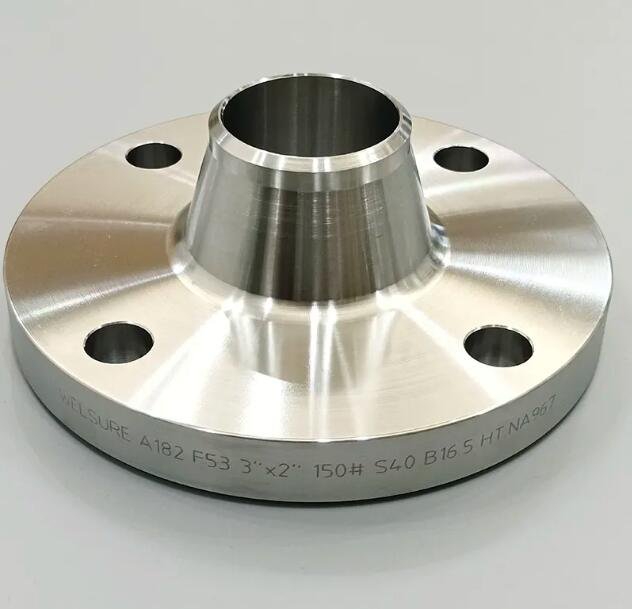
Read the Marking Before You Accept the Delivery
Marking is the cheapest inspection available. ASME B16.5 requires the manufacturer’s name or trademark, the material specification and grade, the class and the nominal size. Forged flanges take their grade from ASTM A182/A182M, while plate-based items reference ASTM A240/A240M. On stainless items the material marking matters most: it separates an A182 F304 flange from an A182 F316 flange, and both from a super duplex F53 flange that costs several times more.
In the photograph above, the rim carries the grade, size pair, class, bore schedule and dimensional standard. That one line lets an inspector check grade against the purchase order, class against the line list, bore against the schedule and the item against a heat number.

Six Mistakes That Show Up in Flange Enquiries
- Treating the class as a pressure. Class 150 is not 150 psi; the table decides, and it depends on temperature and material group.
- Quoting a class without a grade. Class, grade and design temperature together are the minimum needed to confirm a rating.
- Confusing classes with PN numbers. Class 150 and PN 16 sit in different systems with different diameters, bolt holes and gasket envelopes.
- Omitting design temperature. A flange checked only at ambient has not been checked for the service it will see.
- Specifying class but not bore. Bore and schedule decide weld fit-up, and they cause many rejections on delivery.
- Accepting flanges without markings. Grade, class and heat traceability cannot be recovered after the fact.
If your project mixes US and European specifications, the dimensional differences are set out in our ASME B16.5 and EN 1092-1 comparison.
What to Put in the RFQ
An enquiry with these fields complete can be quoted the same day.
- Nominal size and dimensional standard, including edition where the project fixes it
- Pressure class, plus the design pressure and temperature it has to satisfy
- Flange type: weld neck, slip-on, blind, plate, socket weld, threaded or lap joint
- Material specification and grade, for example ASTM A182 F316L, with any impact or corrosion requirement
- Bore and pipe schedule, or the pipe specification it will be welded to
- Facing: raised face, flat face or ring type joint, with gasket type if already selected
- Quantity, marking, inspection level and the documents expected with delivery
Our stainless steel flange inquiry guide expands each field into the questions a supplier will ask anyway. Standard weld neck sizes and classes are listed under weld neck flanges, with blind and plate patterns grouped under pipe flanges. For a specific class, grade and bore combination, send the line data through the contact page and we will confirm against the drawing rather than a catalogue page.
Frequently Asked Questions
Is Class 150 the same as 150 psi?
No. Class 150 fixes dimensions and points to a pressure-temperature table. Allowable pressure at ambient is generally higher than the class number for common material groups, and it falls as service temperature rises.
Can I replace a Class 150 flange with a Class 300 flange?
Not as a direct swap. Thickness, bolt circle and usually bolt count differ, so the mating flange, gasket and studs change with it. Upgrading one side of a joint leaves the connection rated by its weakest component.
Does a higher class always mean a thicker flange?
Thickness generally increases with class at the same size and material, but that is only part of the change. Hub height, bolt circle, bolt size and facing move too, and above Class 600 the facing is usually a ring type joint.
Which stainless grade should I pair with a given class?
The class fixes dimensions, not the alloy. Grade follows the corrosion environment, operating temperature and code: 304 and 316 for general and mildly aggressive service, duplex grades such as F51 and F53 where chloride stress corrosion or higher strength drives the choice. The rating then comes from that group’s table.
Getting the Class Decision Right the First Time
Pressure class is shorthand for three things at once: these are the dimensions, this is the rating table, and this is the marking that proves it. Buyers who read it as a single number end up with flanges that do not fit, or that fit and are under-rated for the temperature the line actually runs at.
Start from design pressure and design temperature, apply the material group for the grade you have chosen, read the rating from the current edition of the standard, then confirm the class against the project specification and a qualified engineer before it reaches the purchase order. Bore, schedule, facing and bolting all follow from that decision.
If you want a second check on class, grade and bore before you commit, send the datasheet through the contact page. We will come back with dimensional confirmation, material options for the service, and the documentation we can provide with delivery.